District of Columbia schools calendar
Roughly 100,000 public school students attend classes in Washington, D.C., split almost evenly between the traditional D.C. Public Schools system and a large network of independent public charter schools. Because the city acts as its own city, county, and state for education purposes, its calendar is shaped by a mayor-led school system, a separate charter authority, and a citywide state education agency, a mix you won’t find in a typical county.
School District Structure in the District of Columbia
Washington, D.C. is not a county, parish, or borough. It is a single municipal jurisdiction divided into eight wards, and its public education is organized differently from anywhere else in the country.
D.C. Public Schools (DCPS) is the traditional district, serving around 50,000 students. It is led by a Chancellor who reports to the Mayor, and the Office of the Chancellor sets the system-wide calendar. DCPS does not have an elected local school board, since the Mayor and D.C. Council hold governance authority.
Public charter schools educate close to half of the city’s public school students. They operate under the D.C. Public Charter School Board (PCSB), which authorizes and oversees them. Each charter school or network has its own board and may set its own calendar, so charter start dates, breaks, and end dates often differ from DCPS.
The Office of the State Superintendent of Education (OSSE) serves as the state education agency. It sets citywide standards, runs state-level assessments, oversees school transportation for students with special needs, and administers licensing and compliance. The elected D.C. State Board of Education sets standards and advises on policy but does not operate schools.
Public meetings for each body are posted on their official websites, so check those for current board and council schedules. The city is fully urban, which means students rely heavily on Metrobus, Metrorail, walking, and biking, and the school day is built around that reality.
Academic Calendar Structure
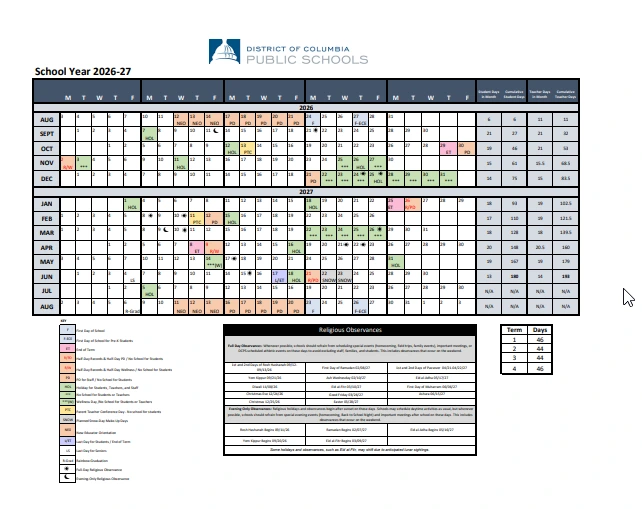
DCPS typically starts the school year in late August, with the last day for students falling in mid-to-late June. The exact dates change every year, and DCPS generally publishes its calendar well in advance, often adopting the following year’s schedule during the preceding school year. Charter schools may start earlier or later, and a few use extended-year or modified schedules.
DCPS organizes the year into four quarters, with report cards issued after each. Many high schools build semester-based course structures on top of that, with fall and spring finals. Charter schools may use quarters, trimesters, or semesters, so families should confirm with each school.
District regulations require a 180-day school year for public schools. DCPS meets this by scheduling 180 student days and building in federal and local holidays, professional development days, and parent-teacher conference periods around that count.
School day hours vary by school and by grade band rather than following one citywide bell schedule. Elementary schools often start in the morning and end mid-afternoon, with middle and high schools running somewhat later start times in some cases. Check your child’s school page for the exact bell schedule, and expect extended-day options at many elementary schools.
School Holidays and Breaks
DCPS observes the major federal holidays, plus a few local ones. A typical year includes:
- Labor Day in early September
- Indigenous Peoples’ Day in October (DCPS has recognized this in place of Columbus Day)
- Veterans Day in November
- Thanksgiving break, usually Wednesday through Friday of Thanksgiving week or a longer stretch
- Winter break, generally about two weeks around Christmas and New Year’s Day
- Martin Luther King Jr. Day in January
- Presidents’ Day in February
- Spring break, usually one week in late March or April, often scheduled near the Cherry Blossom season and close to Easter
- Memorial Day in late May
- Juneteenth, observed in June, which is also a D.C. public holiday
- Emancipation Day on April 16, a D.C.-specific holiday that sometimes affects school scheduling when it falls on a weekday
D.C. residents mark Emancipation Day as a local observance, and it is one reason the D.C. calendar can differ from neighboring Maryland and Virginia schools. Exact dates shift each year, so always rely on the current adopted calendar from DCPS or your charter school.
How to Find the Official D.C. School Calendar
The authoritative source for DCPS is the dcps.dc.gov website, where the current-year calendar is posted as a downloadable PDF, usually under sections for families, students, or calendars. Charter families should go to their school’s own website, since each charter adopts its own calendar. PCSB’s website offers school directories that link to each charter campus.
Individual schools often post supplemental calendars covering concerts, back-to-school nights, athletic events, and spirit weeks, and these are separate from the system-wide calendar. Sign up for your school’s email and text communications so you do not miss updates.
Families comparing calendars across the region sometimes look at neighboring jurisdictions too. For example, if you are weighing a move or have relatives elsewhere, the Sussex County schools calendar shows how a rural-suburban county’s schedule can differ from the District of Columbia schools calendar, where holidays like Emancipation Day and a year-round urban transit environment shape the school year. Reading both side by side is a practical way to see why start dates, breaks, and closure policies vary from place to place.
Early Release Days, Teacher Workdays, and Professional Development
DCPS schedules professional development days when students are not in school, along with teacher workdays before the first day of classes. These dates appear on the official calendar, and many are scheduled around the start of a quarter or just before a major break.
Early dismissal days also appear on the calendar, often tied to parent-teacher conferences or staff training. Schools typically notify families through email, text, robocall, and school websites. Because charters set their own calendars, a day off at a DCPS school may be a regular class day at a nearby charter school, and the reverse is also true. Families with children in both systems should compare calendars early in the summer.
OSSE sets certain requirements for educator licensure and training, and DCPS builds mandatory training into its non-student days.
Emergency Closures and Weather Days
Washington’s weather is more often about ice and a few snowfalls than long winters, but closures happen. DCPS makes closure and delay decisions through the Chancellor’s office in coordination with the Mayor’s office and city emergency management. Charter schools make their own decisions, though many follow DCPS announcements.
Announcements go out through:
- The DCPS website and social media accounts
- The citywide emergency alert system, AlertDC
- Local television stations such as WRC-TV (NBC4), WTTG (Fox 5), WUSA9, and WJLA (ABC7)
- Local radio, including WTOP news radio
- Text and email messages sent to families registered with their school
A federal government shutdown or federal agency closure does not automatically close D.C. schools. The district makes its own decision, so do not rely on federal operating status announcements alone.
Makeup days are handled through the district’s calendar and, when needed, the district can adjust the schedule to meet the 180-day requirement. Families should watch for official notices if the weather forces multiple closures.
Graduation and End-of-Year Schedule
Final exams for DCPS high schools generally occur in the weeks before the end of the school year, in June, with a similar pattern in January for semester courses. High school graduations are typically held in June, and ceremonies take place at school auditoriums, university venues, and other large city spaces, depending on the school’s size.
Elementary and middle schools hold promotion or moving-up ceremonies, usually in the last week or two of school. Report cards are available through the family portal, and DCPS families can use the Aspen parent portal for grades and attendance. Charter schools use their own platforms, so check with your school.
Back-to-School and Registration Information
For families new to D.C., enrollment happens through two main paths:
- DCPS in-boundary enrollment: Students are guaranteed a seat at their neighborhood school based on address. Families can enroll online or at the school.
- My School DC lottery: A common citywide lottery covers public charter schools and out-of-boundary DCPS schools. Application windows generally open in the winter, with results in the spring.
Typical documents include proof of D.C. residency, a child’s birth certificate or other proof of age, and immunization records. D.C. has strict residency verification, so have documents ready. Late and mid-year enrollment remains available through the school or the DCPS enrollment office.
School supply lists are usually posted on school websites over the summer. Back-to-school nights, open houses, and meet-the-teacher events typically take place in the days before and after the first day of classes.
Special Programs and Their Calendar Implications
D.C. has a wide range of programs that can follow different schedules:
- Selective high schools and specialty programs such as School Without Walls and Banneker, which admit by application
- Career and technical education pathways at several high schools
- Dual enrollment and early college options, including partnerships with the University of the District of Columbia and other institutions
- Alternative and adult-oriented programs for older students, including options for students who need flexible schedules
- Pre-K3 and Pre-K4, which D.C. offers publicly and which generally follow the regular school calendar, with some community-based providers following their own schedules
- Extended-year and modified-calendar schools, which may begin earlier or end later than traditional schools
Families should verify schedules with each individual program.
Athletics and Extracurricular Calendar Context
High school sports in the city are governed by the D.C. State Athletic Association (DCSAA), which operates under OSSE and sets seasons, eligibility, and championships for DCPS and charter schools. Fall, winter, and spring sports seasons run alongside the academic year, so practices and games often continue during certain breaks while avoiding final exam periods. Individual schools also run clubs, performing arts, and community programs on their own schedules.
State-Level Calendar Requirements and How D.C. Law Governs the Calendar
Because D.C. functions as its own state for education purposes, OSSE and the D.C. Council establish the rules. Public schools must provide 180 instructional days, and calendar planning has to fit around that, along with required professional development, holidays, and testing windows. OSSE administers statewide assessments, so schools schedule testing windows in the spring and plan instruction around them.
DCPS and PCSB each have flexibility within these rules, which is why charter calendars may vary. The result is a system where the Mayor, Chancellor, D.C. Council, OSSE, and charter boards each influence what a family’s year looks like.
Frequently Asked Questions
When does school start in the District of Columbia?
DCPS typically begins in late August. Charter schools set their own dates, and some start earlier. Check the current calendar for exact dates.
When does school get out for summer?
DCPS usually ends in mid-to-late June. Charter end dates vary.
How many days are in a school year?
D.C. requires 180 instructional days for public schools.
How do I find out if school is cancelled today?
Check the DCPS website and social media, AlertDC, local stations like NBC4, Fox 5, WUSA9, and ABC7, and WTOP radio, plus messages from your school. Charter schools may announce separately.
What is the spring break schedule?
DCPS typically schedules one week of spring break in late March or April. Dates vary by year and by charter school.
How do I enroll my child?
For your neighborhood DCPS school, enroll with proof of residency, age verification, and immunization records. For charters and out-of-boundary schools, apply through the My School DC lottery.
Are there any year-round schools?
D.C. has a small number of schools with extended-year or modified calendars, but most operate on a traditional August-to-June schedule. Check with individual schools.
Who do I contact about calendar questions?
Start with your child’s school office. For system-wide DCPS questions, contact the Office of the Chancellor through the DCPS website. For charter schools, contact the school directly or PCSB.
One Comment