Cassia County Idaho Schools Calendar
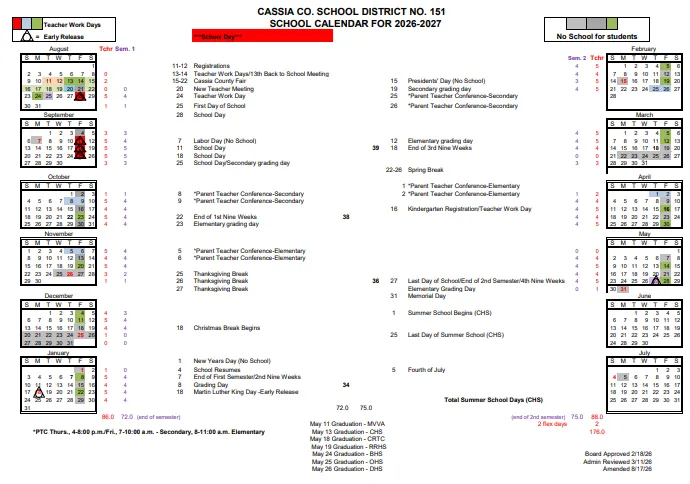
Two public school districts serve roughly 6,500 students across the Magic Valley’s southern edge, where Burley and Declo anchor a farming and food-processing economy along the Snake River and the Raft River valley. Cassia County has no countywide school board, so families in the Burley area and the Declo area follow separate board-adopted calendars that reflect the planting and harvest cycle as much as the usual winter breaks. That agricultural rhythm, combined with a mix of small-city and rural bus routes, gives the county’s school year a practical character that differs from the Treasure Valley suburbs to the northwest.
School District Structure in Cassia County
Idaho organizes public education by independent school district rather than by county, and Cassia County follows that pattern. There is no county board of education and no county superintendent who sets a shared calendar. Each district is governed by an elected Board of Trustees and led by a superintendent hired by that board.
The two public school districts serving the county are:
- Cassia County Joint School District No. 151, the larger of the two, serving Burley, Heyburn, Malta, Albion, Oakley, and surrounding communities across much of the county. Despite the name, it is an independent school district governed by its own Board of Trustees, and it operates several elementary schools, middle schools, and high schools, including Burley High School, Declo-area schools, and Oakley and Raft River-area schools.
- Minidoka County Joint School District No. 331, which extends into a small portion of the area near the county line and primarily serves neighboring Minidoka County. Families near the border should confirm which district serves their address.
Burley, the county seat, is the main urban center, but most of the county is rural or small-town, which shapes transportation, building size, and how much flexibility a district has when weather hits. Trustees typically meet monthly in public sessions, and agendas are posted ahead of time on the district website and at the district office. Because Cassia County Joint School District No. 151 covers a large geographic area, board meetings are often where calendar adjustments, bus route changes, and snow-day decisions are first discussed with the community.
Academic Calendar Structure
Idaho does not set a single statewide first day of school. Cassia County schools generally begin classes in mid-to-late August, sometimes after a few teacher-only days, and finish in late May. Exact dates change each year. The district typically adopts the following year’s calendar in the spring, often after reviewing staff and parent input and comparing options with neighboring districts.
Most schools use a two-semester structure, with the first semester ending near winter break and the second starting in early January. Secondary schools commonly report grades by quarter or semester, while elementary schools may use trimester or quarterly report cards. Check your child’s school handbook for the exact grading windows, since they can vary by school level.
School day hours vary by building. Elementary schools in Burley and Heyburn typically start between about 8:00 and 8:30 in the morning and dismiss in mid-afternoon, while the middle schools and high schools run on their own bell schedules. Smaller outlying schools in places like Oakley, Declo, and Albion often have schedules shaped by long bus routes. Families should confirm start and end times for each child, since siblings at different grade levels may have different pickup times.
Idaho’s school calendars vary a good deal from one county to the next, shaped by local boards, rural travel distances, and winter weather. Families in the Magic Valley, where Burley, Heyburn, and Declo build school years around farming, food processing, and a mix of small-city and rural routines, can review the Cassia County schools calendar to see how start dates, breaks, and early release days line up. Families farther east in the high plateau country, where small districts like Soda Springs, Grace, and North Gem contend with mountain winters and long highway routes, can compare the Caribou County schools calendar to see how a multi-district rural county structures its year. Reading both side by side is a practical way to see how much Idaho calendars differ across regions.
School Holidays and Breaks
Cassia County schools follow a familiar pattern of breaks, though exact days and lengths differ by year.
- Labor Day: Schools are closed on the first Monday of September.
- Fall Break: Not universal in Idaho. Some years include a short break or a few days around parent-teacher conferences in October. Check the adopted calendar.
- Thanksgiving Break: Typically Wednesday through Friday of Thanksgiving week, and sometimes the full week.
- Winter Break: Usually about two weeks spanning Christmas and New Year’s Day.
- Martin Luther King Jr. Day / Idaho Human Rights Day: Observed on the third Monday of January, with schools closed.
- Presidents’ Day: Observed on the third Monday of February.
- Spring Break: Usually one week in late March or early April, set locally.
- Memorial Day: The last Monday of May, close to the end of the school year.
Because the county sits in an agricultural region, some families plan travel and farm work around school breaks, so it helps to look at the calendar early in the year. Exact dates shift annually, so rely on the official district calendar rather than last year’s dates.
How to Find the Official Cassia County School Calendar
Go to the website of the Cassia County Joint School District No. 151, where the calendar is usually found under a menu labeled “District,” “Parents,” “Families,” or “Community.” A printable PDF is commonly posted alongside an online version that can be added to a phone or computer calendar. Families in the portion of the county served by another district should check that district’s site instead.
Calendars are normally approved by the Board of Trustees at a spring meeting for the following school year, though boards sometimes adopt them earlier. Individual schools, including Burley High School and the smaller community schools, often publish supplemental calendars for concerts, conferences, athletic events, and community nights. If a school page and the district page ever disagree, the board-approved district calendar controls. If you cannot find it online, the district office in Burley or the school’s front office can provide a copy.
Early Release Days, Teacher Workdays, and Professional Development
Teacher workdays usually fall in the week or two before classes begin in August. During these days, staff prepare classrooms, attend training, and review safety procedures, and students are not in attendance. Professional development days may also fall during the school year, often near the end of a quarter or semester.
Some schools use regular early release schedules, such as one afternoon a week or month, to give teachers collaboration time, and others cluster early release days around parent-teacher conferences. Because Idaho measures instructional time in hours rather than days, districts have room to arrange these schedules, so read the monthly calendar carefully. Families are usually notified through school newsletters, email, text alerts, parent portals, and social media. Idaho does not impose a uniform statewide set of teacher training days, so the board decides how to schedule staff development within the state’s requirements.
Emergency Closures and Weather Days
Cassia County sits on the Snake River Plain, with the Albion and Raft River mountain areas to the south, so winter weather can differ noticeably across the district. Snow, ice, fog, and blowing snow are the usual reasons for closures and delays, and drifting conditions can make rural routes near Oakley, Albion, and Declo harder to travel than town streets in Burley. Interstate 84 and U.S. 30 carry much of the regional traffic, and incidents on those highways can affect travel times.
Decisions on closures, late starts, and early dismissals are made by the superintendent, usually after checking road conditions early in the morning with transportation staff and sometimes with county road crews. Because the district is large, buses and road conditions may vary from one end of the district to the other, which can lead to partial route changes or delays.
Closures are typically communicated through:
- The district’s automated phone, text, and email notification system
- District and school websites and social media pages
- Magic Valley television and radio stations, including KMVT (Channel 11) in Twin Falls and local stations covering Burley and the Magic Valley
- The Times-News in Twin Falls and the South Idaho Press, the local newspaper in Burley
Make sure your contact information is current in the district’s student information system so alerts reach you. Idaho sets requirements in instructional hours rather than days, so the district can often absorb a small number of lost days through built-in margins or modest schedule adjustments, and in more serious circumstances it may seek approval from the State Board of Education.
Graduation and End-of-Year Schedule
The school year in Cassia County typically ends in late May. High schools generally hold final exams in the last week or two of the year, with some schools using a compressed exam block. Graduation ceremonies for Burley High School and the other high schools in the district are generally held in late May and are major community events, usually in school gymnasiums, stadiums, or large indoor facilities depending on the size of the class. Families should check the school’s website for ticket or seating details.
Elementary and middle schools may mark the end of the year with promotion ceremonies, awards assemblies, or field days. Report cards are usually issued at the end of each term, and parents can follow progress through the student information system. Parent accounts are typically set up through the school office at the start of the year.
Back-to-School and Registration Information
Enrollment and re-enrollment for the next school year typically opens in the spring, and many districts accept online registration through their parent portal. New students can usually register at the school they will attend or at the district office in Burley. Required documents commonly include:
- Proof of residency, such as a utility bill or lease agreement
- The child’s birth certificate or other proof of age
- Immunization records, or a valid exemption form allowed under Idaho law
- Records or a withdrawal form from the previous school, if applicable
Idaho requires children to be five years old by September 1 to enter public kindergarten, and compulsory attendance runs from ages seven through sixteen. Supply lists are generally posted on school websites in the summer, and many schools hold open houses or meet-the-teacher evenings shortly before classes begin. Families moving to rural parts of the county should ask about bus eligibility early, since route planning takes place before the first day of school.
Special Programs and Their Calendar Implications
Several programs in and around the county do not follow the standard calendar exactly.
- Dual credit and college courses: The College of Southern Idaho in nearby Twin Falls is a common partner for dual credit, and some courses are offered online or on campus. College calendars have different start dates, breaks, and exam periods than K-12 schools.
- Career-technical education: Career and technical programs may follow a different schedule from the home high school, especially if students travel to a partner location or take classes at a regional center.
- Alternative schools: The district offers alternative pathways, sometimes with flexible schedules, for students who need a different setting.
- Pre-K and early childhood: Preschool and special education early childhood programs may follow a different calendar from the elementary schools, so confirm dates directly.
- Virtual learning: The Idaho Digital Learning Academy, a state-supported online provider, is widely used by students in rural districts for courses their school does not offer. Its courses run on their own schedule.
Athletics and Extracurricular Calendar Context
High school athletics and activities in Cassia County are governed by the Idaho High School Activities Association (IHSAA), which sets season dates, classifications, and eligibility rules separately from the academic calendar. Burley High School competes in a larger classification than the smaller schools in the county, which affects schedules, travel, and opponents across the Magic Valley and beyond.
Fall sports start in August, often before classes begin, while winter and spring seasons overlap with winter break, exam weeks, and spring break. Weather can affect games and bus travel, so coaches and athletic directors often post schedule changes quickly. Students planning to travel during a break should check their team’s calendar first.
State-Level Calendar Requirements and How Idaho Law Governs Cassia County
The Idaho State Department of Education and the State Board of Education set the framework for local calendars. Idaho law specifies minimum annual instructional hours by grade level, generally 450 hours for kindergarten, 810 for grades 1 through 3, 900 for grades 4 through 8, and 990 for grades 9 through 12. The state does not mandate a fixed 180-day year.
This hour-based approach gives Cassia County flexibility to use five-day, four-day, or hybrid schedules as long as the minimums are met. The Board of Trustees decides start and end dates, holidays, and early release schedules, and it follows Idaho’s legal holidays. Districts report attendance and calendar information to the State Department of Education, which is led by the elected Superintendent of Public Instruction, and funding is tied in part to attendance. That makes careful calendar design and weather planning important for a district covering a large rural area.
Frequently Asked Questions
When does school start in Cassia County, Idaho?
Most schools begin in mid-to-late August, though the board sets the exact date each year. Check the adopted calendar for the first day.
When does school get out for summer in Cassia County?
Classes typically end in late May, depending on the school and how many days were lost to winter weather.
How many days are in a school year in Cassia County?
Idaho sets minimum instructional hours rather than a fixed number of days. A five-day schedule generally runs somewhere around 170 to 180 days, while a four-day-week schedule has fewer but longer days.
How do I find out if school is cancelled today in Cassia County?
Check the district’s alert system, website, and social media pages, and watch KMVT or local Magic Valley stations. Make sure your phone number and email are current in the parent portal.
What is the spring break schedule for Cassia County schools?
Spring break is usually one week in late March or early April. Dates vary by year, so check the adopted calendar before making travel plans.
How do I enroll my child in Cassia County schools?
Contact the district that serves your address, then register online or at the school or district office. Bring proof of residency, a birth certificate, and immunization records.
Are there any year-round schools in Cassia County?
Traditional nine-month calendars are the norm. Fully year-round public schools are not typical here, though summer programs and online options may run on flexible schedules.
Who do I contact about school calendar questions in Cassia County?
Start with your child’s school office, then contact the district office in Burley. The district website lists contact details and board meeting information.
Does Cassia County have more than one school district?
Cassia County Joint School District No. 151 serves most of the county, while a small area near the county line may be served by a neighboring district, so confirm which district serves your address.
One Comment