Los Angeles County California Schools Calendar
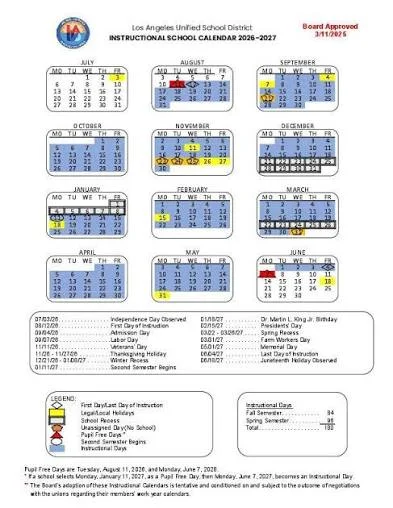
More than 1.4 million public school students attend classes in Los Angeles County, making it the largest concentration of K-12 students in the country, and they are served by roughly 80 separate school districts rather than a single system. There is no countywide calendar. Start dates, breaks, and bell times depend on which district serves your address, and the largest district, Los Angeles Unified, follows a calendar that can differ noticeably from those of neighboring suburban and coastal districts.
School District Structure in Los Angeles County
California organizes public education through locally governed districts, each led by an elected board of education or board of trustees and a superintendent. Los Angeles County is overwhelmingly urban and suburban, with pockets of rural and mountain communities in the Antelope Valley and the Santa Clarita area. The county’s districts range from some of the largest in the nation to single-school districts. Notable examples include:
- Los Angeles Unified School District (LAUSD), by far the largest, serving the city of Los Angeles and several neighboring cities, governed by a seven-member Board of Education and led by a superintendent.
- Long Beach Unified School District, serving Long Beach, Signal Hill, Lakewood, and Avalon on Catalina Island.
- Pasadena Unified, Glendale Unified, Burbank Unified, and Santa Monica-Malibu Unified, serving communities in the central and western parts of the county.
- Pomona Unified, Garvey, Rowland Unified, Hacienda La Puente Unified, and West Covina Unified, serving the San Gabriel Valley and eastern suburbs.
- Torrance Unified, Redondo Beach Unified, Palos Verdes Peninsula Unified, and Culver City Unified, serving the South Bay and Westside.
- William S. Hart Union High School District and Saugus Union, serving the Santa Clarita Valley.
- Antelope Valley Union High School District, Lancaster, Palmdale, and Eastside Union, serving the high desert.
Many districts are unified and cover kindergarten through grade 12, while others split elementary and high school between separate districts, such as the Antelope Valley. Families in those areas may follow two calendars that are close but not identical.
The Los Angeles County Superintendent of Schools leads the Los Angeles County Office of Education (LACOE), one of the largest county offices in the country. LACOE does not set any district’s calendar. It provides fiscal oversight, operates county programs including special education and juvenile court schools, and supports districts with professional development. District boards generally meet in open session on schedules posted under California’s Brown Act, usually once or twice a month, so residents can see when a calendar is scheduled for adoption.
Academic Calendar Structure
Many Los Angeles County districts start in mid-August, though the exact first day varies, and a few begin earlier or later. Most finish in late May or the first weeks of June. LAUSD has typically started in mid-August in recent years, while some coastal and Westside districts have started closer to the end of August or after Labor Day in earlier decades. Calendars for the next year are usually adopted in the spring, and some boards approve them more than a year ahead, so check your own district for the first and last day.
High schools generally use two semesters, with the fall term ending before or just after winter break and the spring semester starting in January. Many elementary schools report by trimester, though semester and quarter systems exist. Your school handbook lists progress report and report card dates.
California requires 180 instructional days or the equivalent minutes. Districts in the county meet this with calendars of roughly 180 student days, adjusting daily minutes to cover minimum days.
Elementary schools generally start between about 8:00 and 8:30 a.m. and dismiss in early to mid afternoon. California’s later-start law requires most non-rural middle schools to start no earlier than 8:00 a.m. and most high schools no earlier than 8:30 a.m., which directly affects Los Angeles County, since nearly all of its districts are non-rural. Rural exemptions can apply to some Antelope Valley or mountain campuses. Check each school’s published bell schedule.
School Holidays and Breaks
Los Angeles County districts observe standard California public school holidays, with dates shifting yearly:
- Labor Day in early September.
- Veterans Day in November, usually a day off.
- Thanksgiving break, often Wednesday through Friday of Thanksgiving week, and sometimes the full week.
- Winter break, typically about two weeks across Christmas and New Year’s Day.
- Martin Luther King Jr. Day in January.
- Presidents’ Day, often a single Monday, with some districts adding a few days.
- Spring break, usually one week in late March or April, though some districts schedule it around Cesar Chavez Day or Easter.
- Memorial Day in late May.
Some districts also observe Cesar Chavez Day, Indigenous Peoples’ Day, or Lunar New Year, particularly in areas with large communities that mark those dates. Families who move between Southern and Northern California or travel to other regions often compare schedules across counties. Parents can read the Los Angeles County schools calendar for district-by-district context across the Los Angeles basin, and for a very different rural setting, the Lassen County schools calendar shows how small high desert and Sierra districts plan around snow and long bus routes. Start dates and break weeks can differ by several days between the two counties, which matters for family travel and shared custody schedules.
Dates change every year, so always confirm them against your district’s current board-adopted calendar.
How to Find the Official Los Angeles County School Calendar
Because the county has about 80 districts, start with the one that serves your child. Visit the website for LAUSD, Long Beach Unified, Pasadena Unified, or the district for your address, and look under “District,” “Parents,” “Community,” or “Calendar.” The adopted calendar is usually a PDF, and many districts offer a version that syncs with phones and computers. LAUSD publishes calendars for its traditional schedule, and some campuses follow different tracks.
Boards typically adopt the following year’s calendar at a spring meeting, and drafts are often discussed publicly first. If you are unsure which district covers your home, the LACOE website and school district locator tools list each district and its contact information.
Individual schools also maintain calendars for open houses, assemblies, conferences, concerts, and sports, so check both the district and the school page.
Early Release Days, Teacher Workdays, and Professional Development
Teachers usually report several days before students return in August for planning and training. During the year, districts schedule professional development days when students stay home, along with minimum days or early release days for staff collaboration, parent conferences, and the days before major breaks. The last day of school is often a minimum day.
These dates appear on the adopted calendar and are repeated through newsletters, automated calls and texts, parent apps, and social media. California requires certain staff trainings each year, often placed on non-student days. In a county where many parents commute long distances or work in entertainment, healthcare, ports, and logistics, early release days can be a real scheduling challenge, and many districts coordinate with after-school programs to help.
Emergency Closures and Weather Days
Los Angeles County rarely closes for snow in the main population centers, though snow can affect mountain and high desert communities, including parts of the Antelope Valley and Wrightwood-area routes. More common disruptions include wildfire and smoke, extreme heat, heavy winter rain and flooding, mudslides near burn areas, power outages, earthquakes, and occasional public safety events. Major fires in recent years, including those that affected Altadena, Pacific Palisades, and Malibu, closed schools, displaced students, and forced districts to coordinate with the county and state.
Closure decisions are made by each district’s superintendent in consultation with fire officials, transportation staff, and county emergency managers. Air quality and evacuation orders weigh heavily, and a closure in one part of the county may not apply to another.
California does not require every lost day to be made up, but districts are funded by attendance and instructional time, and the state allows emergency waiver requests. After major disasters, districts have worked with the state on relief, and each handles lost time under its own policy.
For announcements, watch your district’s automated phone, text, and email alerts, its website, its app, and social media. Local television stations, including KTLA 5, ABC7 (KABC), KNBC 4, KCBS/KCAL, and Fox 11 (KTTV), commonly carry closure information, as do local radio and the county’s emergency alert system. Make sure your school has your current contact information.
Graduation and End-of-Year Schedule
High school final exams usually take place in the last week or two of each semester. Graduation ceremonies in the county typically occur in late May or early to mid June. Larger districts hold ceremonies at school stadiums, community colleges, or major venues, with each school setting its own date, ticket limits, and rules.
Elementary and middle schools usually hold promotion or culmination ceremonies during the final week. Report cards are distributed in print or through student information portals, and families without a login should ask the school office, especially after moving to the area.
Back-to-School and Registration Information
Enrollment and re-enrollment for the next year often open in the spring, with registration continuing through summer. Families new to Los Angeles County can usually register at their neighborhood school, the district office, or through an online portal, which is increasingly the first step in larger districts.
Districts typically ask for:
- Proof of residency, such as a utility bill or lease.
- A birth certificate or other proof of age.
- Immunization records, as required under California law.
- Prior school records, especially for middle and high school students.
Because Los Angeles County has many choice programs, magnet schools, charters, and permit options, families often need to apply separately for those, sometimes months before the school year begins. Supply lists are generally posted in late summer, and many schools hold back-to-school nights, open houses, or kindergarten orientations around the first weeks of school.
Special Programs and Their Calendar Implications
- Magnet and specialty schools: LAUSD and other districts operate magnet programs, performing arts schools, and career academies that may use different application and schedule timelines.
- Dual enrollment and early college: Students may take courses at Los Angeles community colleges, Pasadena City College, Long Beach City College, and others, which follow college calendars that differ from high school calendars.
- Alternative and continuation schools: These may have flexible or modified calendars, and LACOE operates court and community schools for specific student groups.
- Transitional kindergarten and preschool: California’s expanded transitional kindergarten and state preschool programs may have different hours or start dates.
- Virtual and independent study options: Many districts offer independent study or online programs with their own check-in schedules.
- Year-round schedules: A small number of campuses in the county have historically used year-round or multi-track calendars, so check the school directly.
Athletics and Extracurricular Calendar Context
High school athletics in Los Angeles County fall under the California Interscholastic Federation (CIF), primarily the Southern Section and the Los Angeles City Section, which governs LAUSD schools. Schedules are separate from the academic calendar but linked to it. Fall practices often begin before classes start in August, games can land on early release days or exam weeks, and playoffs sometimes run past the last day of school. Poor air quality and extreme heat can postpone events, and traffic across the county can affect travel times.
State Law and the California Calendar
The California Education Code and the California Department of Education set the baseline. Districts must offer at least 180 instructional days or the equivalent minutes: 36,000 in kindergarten, 50,400 in grades one through three, 54,000 in grades four through eight, and 64,800 in grades nine through twelve. Falling short can reduce state funding.
Within those limits, local boards choose start and end dates, holidays, and breaks, and they negotiate calendar items with employee unions, which has a large effect on timing in a county as heavily unionized as Los Angeles. LACOE supports districts in staying compliant.
Frequently Asked Questions
When does school start in Los Angeles County, California?
Many districts start in mid-August, but each sets its own date. Check your district’s adopted calendar.
When does school get out for summer in Los Angeles County?
Most schools finish in late May or early June, depending on the district and any closures during the year.
How many days are in a school year in Los Angeles County?
California requires at least 180 instructional days or the equivalent minutes, and county districts build their calendars to meet that.
How do I find out if school is cancelled today in Los Angeles County?
Watch for your district’s phone, text, or email alerts, check its website, app, and social media, and follow local stations such as KTLA 5, ABC7, and NBC4.
What is the spring break schedule for Los Angeles County schools?
Spring break is usually one week in late March or April. Dates differ by district, so confirm yours.
How do I enroll my child in Los Angeles County schools?
Contact your neighborhood school or district office, or use an online portal if available. Bring proof of residency, a birth certificate, and immunization records.
Are there any year-round schools in Los Angeles County?
Most schools follow a traditional August-to-June calendar, though a few campuses use year-round or modified calendars. Confirm with your school or district.
Who do I contact about school calendar questions in Los Angeles County?
Start with your child’s school or district office. LACOE can point you to the right contact if you are unsure which district serves you.
One Comment