San Francisco County California Schools Calendar
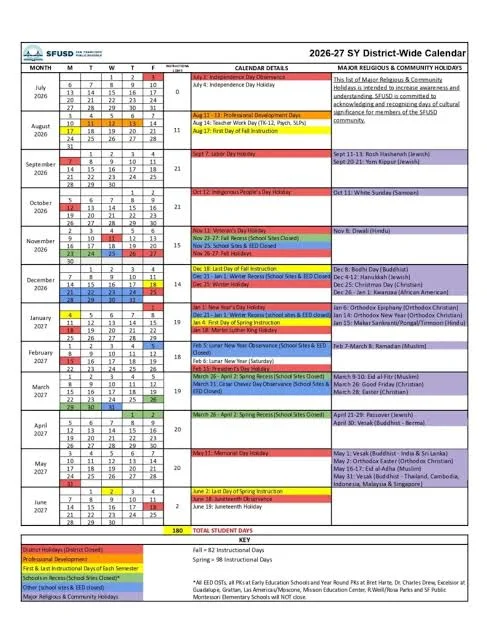
About 50,000 students attend public schools in San Francisco, California, where a single district, San Francisco Unified School District, serves a county that is also a consolidated city, which makes its calendar unusually uniform compared with most California counties. Families here follow one main adopted calendar, with charter schools and a few specialty programs adding their own variations.
School District Structure in San Francisco County
San Francisco is both a city and a county, one of the few consolidated city-county governments in the nation, and it is the only California county served by a single unified district. The San Francisco Unified School District (SFUSD) is governed by the elected San Francisco Board of Education, whose seven members set district policy, adopt the budget, and approve the academic calendar. The superintendent leads the district’s central office on Franklin Street. Board meetings are held in public session on a regular schedule posted on the district website, and the public can comment in person or in writing.
The San Francisco County Office of Education (SFCOE) operates alongside SFUSD, with the county superintendent role held by the SFUSD superintendent. The office oversees county-level responsibilities such as fiscal review and services for court and community school students, but it does not set a separate calendar. Because the county is entirely urban and densely populated, there are no rural districts, no feeder splits, and no boundary confusion of the kind seen in counties like San Diego or San Bernardino. A family moving from the Sunset to the Excelsior stays on the same calendar.
SFUSD runs elementary, K-8, middle, and high schools, including academically selective Lowell High School and the arts-focused School of the Arts. Charter schools such as Gateway, KIPP, and Creative Arts Charter operate within city limits and adopt their own calendars.
Academic Calendar Structure
SFUSD typically begins the school year in mid-August and ends in late May or early June. Exact first and last days change each year. The Board of Education usually adopts the calendar well in advance, often a year or more ahead, so families can plan around it. Check the district website for the adopted dates rather than relying on earlier years.
High schools run on a two-semester schedule, with the first semester ending before or shortly after winter break depending on the adopted calendar. Elementary schools commonly report progress by trimester or semester. Confirm the reporting periods for your child’s school in the district calendar.
California requires 180 instructional days and sets minimum instructional minutes by grade level: 36,000 for kindergarten, 50,400 for grades one through three, 54,000 for grades four through eight, and 64,800 for grades nine through twelve. SFUSD meets those totals through regular days plus a limited number of shortened days.
Bell times vary by school. Many elementary schools start between about 7:50 and 8:40 a.m. and end in mid-afternoon, which is more varied than in many districts because SFUSD staggers start times across neighborhoods. State law bars middle schools from starting before 8:00 a.m. and high schools before 8:30 a.m., with limited exceptions. Check each school’s page for its bell schedule.
School Holidays and Breaks
Standard closures on the SFUSD calendar usually include:
- Labor Day in early September
- Veterans Day on or near November 11
- Thanksgiving break, typically most of the week
- Winter break of about two weeks around Christmas and New Year’s Day
- Martin Luther King Jr. Day in January
- Presidents’ Day, often with a mid-February break
- Spring break, typically one week in late March or April
- Memorial Day in late May
Fall break of the Tennessee type is not standard. SFUSD has also recognized days tied to the city’s communities, including observances such as Lunar New Year in some years, Cesar Chavez Day, and Juneteenth when it falls in the school year. Whether these appear in a given year depends on the board’s adopted calendar. Holidays shift each year, so the adopted calendar is the only reliable source.
How to Find the Official San Francisco County School Calendar
Because the county has one district, the process is simple. Visit the San Francisco Unified School District website and look under “Calendar,” “Families,” “Parents,” or “Community” for the board-adopted calendar, which is typically posted as a PDF and often available as a feed for phone or email calendars. The district also posts calendars in multiple languages, reflecting the city’s Chinese-, Spanish-, and Filipino-speaking communities.
Calendars are approved at a public Board of Education meeting, and the agenda packet is posted in advance so you can see proposed dates before the vote. Individual schools maintain supplemental calendars for back-to-school nights, concerts, picture days, and field trips, and athletics live on separate pages.
Families relocating around the state often compare how calendars work from one county to the next. If you are curious how a large, multi-district southern coastal county handles it, you can read about the San Diego County schools calendar, or return to the San Francisco County schools calendar overview here for city-specific details.
Early Release Days, Teacher Workdays, and Professional Development
Teachers in San Francisco typically report several days before students return in August for planning and training. During the year, pupil-free days are scheduled for professional development, grading, and parent conferences. SFUSD has historically used weekly early dismissal or late start schedules at some schools to give teachers collaboration time, so families should confirm the pattern at their child’s school.
Early release days affect working families in a city with high child care costs, so many families rely on after-school programs run through the district’s expanded learning office and community partners. SFUSD announces schedule changes through the annual calendar, school newsletters, and notification tools such as ParentSquare and automated calls, texts, and emails, with translation in several languages.
California requires certain staff training, including mandated reporter training, but does not set a fixed number of pupil-free days. SFUSD and its teachers’ union negotiate those days locally.
Emergency Closures and Weather Days
San Francisco does not have snow days. The more likely disruptions are wildfire smoke, severe winter storms, power outages, extreme heat events, and earthquakes, since the city sits near the San Andreas and Hayward faults. Smoke from regional wildfires has at times pushed air quality into unhealthy ranges and led to indoor days or school closures, as in recent fall seasons. Atmospheric river storms can cause flooding in low-lying areas, and a major earthquake could prompt building inspections before schools reopen.
The superintendent decides on closures, typically after consulting facilities, transportation, and city emergency officials. Notices go out through the district’s automated call, text, and email system, the district website, and social media. Local outlets include KRON 4, KTVU Fox 2, KPIX CBS 5, ABC7 News, NBC Bay Area, the San Francisco Chronicle, KQED, and Spanish- and Chinese-language outlets.
California does not require districts to make up every closure day as some states do, but SFUSD must meet instructional day and minute requirements to receive full state funding. For significant closures, the district can seek a waiver from the California Department of Education. Ask the district how makeup time is handled in a given year.
Graduation and End-of-Year Schedule
High school finals usually fall in the last week or two before winter break or in January, and again in late May or early June, depending on the semester structure. Graduations are generally held in late May or early June, with some schools using their own auditoriums or gyms and others using larger venues across the city.
Elementary and middle schools hold promotion or moving-up ceremonies in the final week or so. Report cards are issued by semester or trimester, and families can check grades through a student information portal. If you do not have login credentials, contact the school office.
Back-to-School and Registration Information
SFUSD uses a centralized enrollment process rather than neighborhood-only assignment. Families apply through the district’s Educational Placement Center, typically during a main enrollment window that opens in the fall or winter before the school year, with results announced in the spring. Families who miss the main round can enroll later, but options may be limited at popular schools, so apply early.
Typical documents include proof of residency, a birth certificate or other proof of age, and immunization records. California does not permit personal belief exemptions, so check requirements with the school nurse or district office. The Educational Placement Center helps families in several languages, and online registration is available.
Supply lists are usually posted in late summer on school websites. Orientations, open houses, and back-to-school nights tend to appear in the first weeks of the year. Transitional kindergarten is available to all four-year-olds statewide and generally follows the elementary calendar.
Special Programs and Their Calendar Implications
Several programs may run on different schedules. Citywide specialty schools, language immersion programs in Spanish, Cantonese, Mandarin, and Korean, and arts and STEM programs generally follow the district calendar but may have their own performance and audition schedules. Charter schools set their own calendars, though many follow the district’s major holidays. Continuation, community, and alternative programs may have different start dates or session lengths.
Dual enrollment and early college students should follow two calendars. City College of San Francisco, San Francisco State University, and other local colleges run on college schedules whose finals and breaks do not always match high school dates. Preschool and early childhood programs, including state preschool and Head Start, may follow different calendars from the K-12 schools. Independent study and virtual options are available, and each sets its own calendar, so confirm dates directly with the program.
Year-round calendars are not used in the district, with traditional August-to-June scheduling the norm.
Athletics and Extracurricular Calendar Context
High school athletics in San Francisco fall under the California Interscholastic Federation, and the city’s public schools compete in the San Francisco section of CIF, commonly known as the San Francisco Section, with leagues such as the Academic Athletic Association and Academic Athletic League. Season dates, eligibility rules, and playoff schedules are set at the state and section level. Fall, winter, and spring sports do not always match the academic calendar, so football playoffs, basketball tournaments, and spring competitions can overlap with holidays and exam weeks. Each school’s athletics page posts schedules separate from the academic calendar.
State-Level Calendar Requirements and How California Law Governs San Francisco County
The California Department of Education sets the framework. State law requires 180 instructional days and specifies minimum instructional minutes by grade level, but gives local boards wide latitude over start and end dates, break timing, and the mix of regular, minimum, and pupil-free days. State law also limits how early middle and high schools may begin, and employee bargaining agreements shape staff development days and early release schedules.
SFUSD is funded based on attendance and must stay in compliance with instructional requirements. The California Department of Education publishes guidance on waivers, minimum days, and emergency closures. Because the Board of Education adopts the calendar, the district’s published dates, not those of a neighboring county, govern your child’s year.
Frequently Asked Questions
When does school start in San Francisco County, California?
SFUSD typically begins in mid-August. The exact first day varies by year, so check the board-adopted calendar.
When does school get out for summer in San Francisco County?
Most schools end in late May or early June, with high school graduations in the final week or two.
How many days are in a school year in San Francisco County?
SFUSD provides about 180 instructional days and meets California’s minimum instructional minutes by grade level.
How do I find out if school is cancelled today in San Francisco County?
Check the SFUSD website and social media, watch for automated calls, texts, or emails, and follow KRON 4, KTVU, KPIX, ABC7, or NBC Bay Area.
What is the spring break schedule for San Francisco County schools?
Spring break is typically one week in late March or April. The board sets the dates each year, and they may or may not align with Easter.
How do I enroll my child in San Francisco County schools?
Apply through SFUSD’s Educational Placement Center, usually during the main enrollment window in the fall or winter. You will need proof of residency, proof of age, and immunization records.
Are there any year-round schools in San Francisco County?
No. Traditional calendars are the norm, though some charter or alternative programs may use different schedules, so ask the specific school.
Who do I contact about school calendar questions in San Francisco County?
Contact your child’s school or the SFUSD central office first. For enrollment questions, the Educational Placement Center can help.
One Comment