Washington County Colorado Schools Calendar
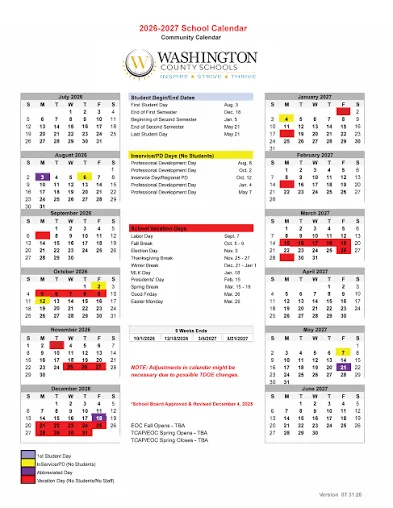
Five small public school districts, not one county-wide system, educate the children of Colorado’s northeastern plains. Washington County’s calendars are shaped by long bus routes, farm-country schedules, and a number of districts that run shorter weeks. Because each district adopts its own calendar, families here learn quickly that “the county calendar” really means several of them.
School District Structure in Washington County
Washington County, seated at Akron, is a rural county on Colorado’s Eastern Plains. Its public education is divided among independent districts, each governed by its own elected Board of Education, with a superintendent who runs daily operations:
- Akron School District R-1, based in Akron, the county seat and largest community
- Arickaree School District R-2, serving the Anton area
- Otis School District R-3, serving Otis and surrounding farmland
- Lone Star School District 101, in the Otis area
- Woodlin School District R-104, serving the Woodlin community
The “R” in a name such as R-1 or R-2 stands for “reorganized,” a Colorado designation for districts consolidated under the state’s reorganization laws. Each board meets on a schedule it sets itself, usually monthly, and posts agendas on the district website. Meetings are open to the public, and the calendar is typically a board action item in the spring.
Total enrollment across the county is small, on the order of one thousand students. Some districts have only a few dozen. That scale affects the calendar in practical ways. A single bus driver or a single winter storm can influence decisions, and there is little room for the multiple-track or staggered schedules common in large Front Range districts.
Some students also cross district lines through open enrollment, so a family living in one district may attend school in another. If that is you, follow the calendar of the district your child attends, not the one for your home address.
Academic Calendar Structure
Colorado has no statewide first day of school, so Washington County districts choose their own start dates. In rural eastern Colorado, classes generally begin in mid-to-late August and end in mid-to-late May, though each district sets its own pattern. Colorado districts usually adopt the calendar for the next school year in the spring, and the final version appears on the district website over the following months. I have not listed specific dates here because they change every year and differ between the five districts.
Most districts here follow a two-semester structure, with the fall semester ending shortly before or after winter break and the spring semester running through May. Elementary report cards may be issued by quarter or trimester, while secondary schools commonly use semesters with quarter progress reports. Check the student handbook of your district for its grading periods.
Instructional time. Colorado law requires a minimum number of instructional hours rather than a simple day count. The standard is 1,080 hours for secondary grades, 990 for elementary, and a reduced figure for kindergarten, with the traditional benchmark being an average of 160 days. The hours-based rule is why several Eastern Plains districts can operate a four-day school week: they lengthen each school day and remain compliant. Four-day weeks are common in rural eastern Colorado, with Mondays or Fridays off, and they appear in several county districts’ calendars. Families should confirm which weekday is the non-student day for their specific school.
Daily schedules. Bell times differ by district and building. Typical patterns have elementary students starting between roughly 7:45 and 8:30 a.m., with middle and high school on similar or slightly later schedules. Four-day districts usually end later in the afternoon. Because some bus routes cover long rural distances, pickup can be early even when the first bell is not.
School Holidays and Breaks
Holiday breaks in Washington County districts follow familiar national patterns, adjusted by local boards:
- Labor Day in early September is observed as a day off.
- Fall break is common in Colorado and may appear in October or around parent-teacher conferences, depending on the district.
- Thanksgiving break typically covers the days around the holiday, often the full week.
- Winter break usually lasts about two weeks, spanning Christmas and New Year’s Day.
- Martin Luther King Jr. Day is observed in January.
- Presidents’ Day is observed in February in most districts.
- Spring break generally falls in March or early April, often close to the Easter weekend, but each board chooses.
- Memorial Day in late May falls near the end of the year.
Colorado has no statewide fall or spring break requirement. The dates move every year, so rely on the board-adopted calendar for your district.
For families who also follow other Colorado school systems, the contrast is worth noting. Mountain districts plan around snow and tourism seasons, while the plains plan around harvest and distance. If you want to see how a mountain county handles the same decisions, the Teller County schools calendar provides a useful comparison to the Washington County schools calendar, especially in how breaks, start dates, and weather planning differ between Eastern Plains and Front Range foothills districts.
How to Find the Official Washington County School Calendar
Because there is no single county calendar, start with the website of your child’s district: Akron R-1, Arickaree R-2, Otis R-3, Lone Star 101, or Woodlin R-104. Most post calendars as PDFs under headings such as “District,” “Parents,” or “Community.” Some small districts also share calendars on a school Facebook page or through a mobile app.
The board adopts the calendar at a public meeting, usually in spring for the following year. Minutes and agendas show when that vote occurred. If you cannot find the document, call the district office. In small districts, a phone call often gets a quicker answer than a website search.
Individual buildings may publish supplemental calendars for athletic events, concerts, parent-teacher conferences, and community nights. Treat the board calendar as the authority on attendance days and the school calendar as the guide for events.
Early Release Days, Teacher Workdays, and Professional Development
Washington County teachers return before students for in-service days. They use these days for training, curriculum planning, and classroom preparation. During the year, districts also schedule professional development days when students are not in attendance, and some use early-release afternoons for staff collaboration.
Because many districts here use four-day weeks, they often use the non-student day for teacher training, which reduces the number of whole days lost to meetings. Colorado requires districts to follow state training expectations, such as educator evaluation and licensure-related professional learning, but it does not set a uniform number of professional development days.
Families usually learn about early releases through the printed calendar, school newsletters, automated phone or text messages, or social media. Parents of bus riders should ask how early releases affect routes, since transportation may leave earlier than usual.
Emergency Closures and Weather Days
Winter weather is the most common reason for disruptions on the Eastern Plains. Blizzards and drifting snow can close county roads and state highways, including routes near Akron, even when snowfall is modest. Superintendents make closure and delay calls, usually early in the morning after checking road conditions and consulting with bus staff and county road crews. Wind and ground blizzards, not just snow totals, drive many decisions.
Colorado does not set a statewide makeup-day rule. Because the state counts instructional hours, districts decide how to cover lost time. Some build extra time into the calendar, some extend days, and four-day-week districts may use their off day as a makeup day. Ask your district what its policy is, since it differs by board.
How closures are announced. Districts commonly use automated calls, text messages, email, their website, and social media. Denver television stations also report closures for the plains. Local weekly newspapers such as the Akron News-Reporter are better for background than same-day alerts, so sign up for your district’s notification system. Confirm that the school has your current phone number on file.
Graduation and End-of-Year Schedule
Final exams typically take place during the last week or two of the second semester, with high school finals concentrated in one stretch. Graduation ceremonies are usually held in May, often in the school gymnasium or a community venue, and they are a major community event in towns of this size. Elementary and middle schools may hold promotion or recognition ceremonies in the final week.
Report cards are distributed at the end of each grading period, and many districts use an online student information portal for grades and attendance. Contact your school office for portal access if you have not received login information.
Back-to-School and Registration Information
Enrollment for returning students usually opens in spring or early summer, and new-student registration continues through the summer and into the school year. Contact the district office or the school directly. In small Washington County districts, registration is often handled by the school secretary or district office, and some districts offer online forms.
Families should expect to provide:
- Proof of residency, such as a utility bill or lease
- A birth certificate or other proof of age
- Immunization records, or a Colorado-recognized exemption form
- Prior school records, if transferring
Supply lists generally appear on district or school websites in the summer. Open houses and meet-the-teacher events usually take place shortly before classes start, and they are posted on the district calendar.
Special Programs and Their Calendar Implications
Small districts do not run many magnet schools, but programs can still affect calendars. Preschool through the Colorado Universal Preschool Program may follow different days or hours than K-12. Some students take dual enrollment or concurrent enrollment courses through nearby community colleges, such as Northeastern Junior College in Sterling, which follows its own college calendar. Students should compare both calendars to avoid conflicts around breaks and finals.
Northeast Colorado BOCES, a cooperative serving rural districts in the region, supports special education and other services, and BOCES programs may run on a different schedule. Online and hybrid options are available through Colorado’s statewide system, and a district counselor can explain which are open to local students. Alternative or credit-recovery options, where offered, are arranged by the home district.
Athletics and Extracurricular Calendar Context
High school athletics in Colorado are governed by the Colorado High School Activities Association (CHSAA). CHSAA sets season dates, classifications, and eligibility rules. Many Washington County schools compete in small-school classifications and in six-man or eight-man football where numbers are low, and teams often travel long distances.
Athletic schedules are separate from the academic calendar but linked to it. Games and practices may occur during breaks, and eligibility often depends on grades at specific points in the semester. Four-day schools frequently schedule practices and games on the non-class day.
State-Level Calendar Requirements and How Colorado Law Governs Washington County
The Colorado Department of Education (CDE) oversees state education policy, while local boards hold broad authority over calendars under Colorado’s local control tradition. The state sets minimum instructional hours, not exact start and end dates, and it does not require a particular number of snow days or holidays.
That structure is why five neighboring districts can look different from one another. A board must meet the hour requirements, but it can choose a five-day or four-day week, set its own breaks, and decide how to make up weather losses. Districts that want to deviate from standard time requirements can request approval from CDE.
Frequently Asked Questions
When does school start in Washington County, Colorado?
Most districts start in mid-to-late August, but each of the five districts sets its own date. Check your district’s adopted calendar.
When does school get out for summer in Washington County?
Classes generally end in mid-to-late May, with graduation ceremonies in May. Exact dates depend on the district.
How many days are in a school year in Washington County?
Colorado requires minimum instructional hours (about 1,080 for secondary and 990 for elementary), traditionally averaging 160 days. Districts on four-day weeks have fewer, longer school days.
How do I find out if school is cancelled today in Washington County?
Use your district’s automated call, text, or email system, its website and social media, and Denver television station alerts. Call the district office if you are unsure.
What is the spring break schedule for Washington County schools?
Spring break usually falls in March or early April. Because each district adopts its own, check your calendar.
How do I enroll my child in Washington County schools?
Contact the district office or school you want to attend. Bring proof of residency, a birth certificate, and immunization records.
Are there any year-round schools in Washington County?
Washington County districts generally follow traditional calendars, and some run four-day weeks. Year-round schedules are not typical here, so confirm with your district.
Who do I contact about school calendar questions in Washington County?
Contact the district office for Akron R-1, Arickaree R-2, Otis R-3, Lone Star 101, or Woodlin R-104, depending on where your child attends.
One Comment