Hawaii County Hawaii Schools Calendar
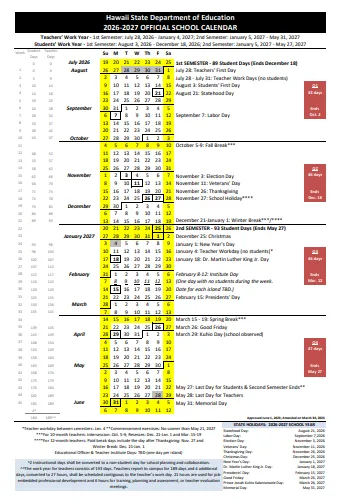
he Island of Hawaii, the largest in the state, has no school district of its own. Its public schools belong to the Hawaii State Department of Education, the only statewide school system in the country, which serves roughly 22,000 students across the island’s traditional public and charter schools. That shared structure gives Hawaii County a calendar set at the state level, though the island’s size, volcanic landscape, and distance between communities such as Hilo, Kona, Waimea, and Pahoa shape how each school lives it out.
School District Structure in Hawaii County
Hawaii County is a single county that covers the entire Island of Hawaii, and it does not have a county or city school board. Public education across all Hawaiian islands is run by the Hawaii State Department of Education (HIDOE), overseen by the Hawaii State Board of Education, whose members are appointed rather than elected. The Superintendent of Education leads the department from Honolulu, so the calendar is not adopted by a local board the way it is in most mainland counties.
On the Big Island, schools are organized into complexes, which are a high school and the elementary and middle schools that feed into it, and complexes are grouped into complex areas led by complex area superintendents. The Hilo, Waiakea, Keaau, Pahoa, and Kau areas sit on the east and southeast side, while Honokaa, Kohala, Kealakehe, and Konawaena cover the north and west. Charter schools, including several on the island, are public but run by their own governing boards, so their calendars can differ from the standard school year.
The State Board of Education meets regularly in public session, with agendas posted on its website. Hawaii County is a mix of small towns, rural farming and ranching areas, and resort communities, and many students ride buses along long highways between districts. Transportation and distance matter here more than almost anywhere else in the state.
Academic Calendar Structure
HIDOE publishes a statewide calendar, and the Big Island follows it. The school year has typically opened in early August and closed in late May. I have not confirmed the dates for the current year. The department usually releases the next year’s calendar well ahead of time, often in the preceding school year, and it appears on the HIDOE website.
The year is divided into two semesters. The fall semester runs from the August start through the last school day before winter break, and the spring semester begins in early January and runs to late May. Many schools also report progress by quarter, so families should expect report cards or progress updates at set points, with the exact schedule varying by school level.
Hawaii law sets a minimum of 180 instructional days for public school students, and the statewide calendar is built to meet it. Hawaii has also had times when it reduced days because of budget issues, so confirm that the current calendar reflects the full requirement. Bell schedules vary by school, with elementary schools generally starting earlier than most high schools, and bus routes on the island influence start and dismissal times. Check your child’s school for current times.
School Holidays and Breaks
The Hawaii calendar follows many standard holidays but also includes some unique to the state. In a typical year, expect the following:
- Labor Day: First Monday in September, no school.
- Statehood Day: Observed on the third Friday in August, so schools are often closed shortly after the year starts.
- Fall Break: A week-long break in October, which sets Hawaii apart from many mainland districts.
- Veterans Day and Election Day: Observed when they fall on school days, with Election Day typically in even-numbered years.
- Thanksgiving Break: Usually the Thursday and Friday, sometimes with additional days.
- Winter Break: About two weeks around Christmas and New Year’s Day.
- Martin Luther King Jr. Day and Presidents’ Day: Observed on their respective Mondays.
- Prince Kuhio Day: Observed around March 26 to honor Prince Jonah Kuhio Kalanianaole.
- Spring Break: Usually one week in March.
- Good Friday and Memorial Day: Observed as state holidays.
Exact dates change every year, so use the official HIDOE calendar for travel and child care planning. Kamehameha Day on June 11 is a state holiday that usually falls after the school year ends.
How to Find the Official Hawaii County School Calendar
The authoritative source is the Hawaii State Department of Education website, which hosts the statewide school calendar as a downloadable PDF. Because the department adopts the calendar at the state level, there is no separate Hawaii County calendar. Look under sections labeled “Calendar” or “Families” and check the posting date to make sure you are viewing the correct year.
Individual schools on the island also keep their own calendars for open houses, concerts, field days, testing windows, and athletics. These supplement the statewide calendar but do not replace it. Charter school families should check their own school’s website, since charters can set different dates. Many parents also sign up for school and department notifications so changes reach them directly.
Early Release Days, Teacher Workdays, and Professional Development
Not every weekday on the calendar is a student day. Teachers report for planning days before students arrive in early August. During the year, HIDOE schedules a limited number of professional development days, sometimes called teacher work days, when students stay home. Hawaii is also known for scheduled non-student days tied to its teacher contract.
Early release days shorten the school day, often so teachers can plan or train. In Hawaii County, these are typically shown on the statewide calendar and repeated through school messaging, websites, and notes sent home. Hawaii requires recurring staff training in areas such as safety and mandated reporting, and some of it is handled on teacher workdays. If a schedule changes, schools notify families through their usual channels, so keep your contact information current.
Emergency Closures and Weather Days
The Big Island faces hazards that most counties never consider. Hurricane and tropical storm threats peak between June and November, and while direct hits are rare, heavy rain, flooding, and high winds can close schools. Tsunami warnings, brush fires, and earthquakes also affect school operations. Volcanic activity from Kilauea and Mauna Loa can produce vog, ashfall, and road closures, and the 2018 eruption in lower Puna showed how a single event can disrupt schools and transportation for months.
Closure decisions are made at the state and complex-area level, working with county civil defense, public safety officials, and the Superintendent of Education. Decisions can be made the night before when a storm is approaching or early in the morning when conditions change quickly. Closures are announced through the HIDOE website, school messaging systems, and social media, and reported by outlets such as KITV, KHON, Hawaii News Now, the Hawaii Tribune-Herald, West Hawaii Today, and Big Island Now. School buildings may also serve as emergency shelters during hurricanes, which can extend closures.
For makeup days, the state generally requires that instructional day totals be met, and the department can adjust the calendar when closures are significant. Because Hawaii is a single statewide system, a decision about makeup days applies broadly rather than being left to a local board.
Graduation and End-of-Year Schedule
High school final exams take place at the end of each semester, with the spring window arriving in the second half of May. The Hawaii State Assessment is given in spring, scheduled by the department.
Graduation ceremonies on the island are typically held in late May, with each high school announcing its own date and venue. Hilo, Waiakea, Keaau, Pahoa, Honokaa, Kohala, Konawaena, Kealakehe, and Kau high schools each hold their own ceremonies, and many are community-wide events. Elementary and middle schools may hold promotion or awards ceremonies during the final week. Report cards are distributed or posted at the end of the year, and families can follow grades through the HIDOE parent portal, which uses Infinite Campus. Confirm your login before final grades post.
Back-to-School and Registration Information
Families should watch for registration and re-enrollment in spring and summer. Kindergarten students must turn five by July 31 of the school year. Because Hawaii uses geographic school attendance areas, enrollment is based on where you live, and the department offers a geographic exception process in some cases.
To enroll, families generally need:
- Proof of residency, such as a lease, utility bill, or property record
- A certified birth certificate
- Immunization records, including a Hawaii-required tuberculosis clearance
- A completed student registration form
- Prior school records, when transferring
Registration is typically handled at the student’s assigned school, with some online options. Supply lists are usually posted on school websites or social media in July. Open houses and meet-the-teacher events appear on individual school calendars rather than the statewide one.
Special Programs and Their Calendar Implications
Hawaii County does not operate magnet schools in the mainland sense, but it has several programs that follow slightly different rhythms.
Hawaiian immersion schools, known as Kula Kaiapuni, operate within the public system and follow the statewide calendar. Public charter schools on the island may set their own dates. The Executive Office on Early Learning runs public pre-kindergarten classes at select schools, and those calendars may differ from K-12. High school students can take dual credit courses through programs with the University of Hawaii at Hilo, University of Hawaii Hawaii Community College, and University of Hawaii West Hawaii, and those colleges keep their own semester dates. Virtual learning is available through the HIDOE E-School program, which has its own enrollment and pacing windows. Alternative education options are offered through the department, so ask your complex area office for current details.
Athletics and Extracurricular Calendar Context
High school athletics in Hawaii are governed by the Hawaii High School Athletic Association (HHSAA), which sets state-level championships. On the Big Island, the Big Island Interscholastic Federation (BIIF) organizes league play among island schools. These calendars are separate from the academic calendar but linked to it. Fall sports such as football and cross country begin soon after school starts, winter sports like basketball and soccer run through the holiday break, and spring sports overlap with May exams and testing. Because teams may need to fly to other islands for state tournaments, schedules can involve extra travel time, and games may be rescheduled during storms or other emergencies.
State-Level Calendar Requirements and How Hawaii Law Governs Hawaii County
In Hawaii, the state does more than set minimum standards. It runs the entire public school system. State law requires 180 instructional days, and the Hawaii State Department of Education and Board of Education design the calendar around that requirement and the collective bargaining agreement with teachers. Unlike mainland states, where local boards adopt calendars, Hawaii County families are subject to a single statewide schedule.
Families who compare regions quickly see how differently calendars can work. The Hawaii County schools calendar follows a statewide system run by one department, with island-specific concerns such as volcanic activity, hurricane season, and long distances between communities shaping how schools operate. The Worth County schools calendar comes from a south Georgia agricultural district in Sylvester, where a local board adopts the calendar and harvest season and tornado watches influence planning. Both aim to meet instructional day requirements, yet the way each calendar is built and adopted is very different.
For Hawaii County, the framework means the department must schedule enough days to reach 180, plan for emergencies unique to the islands, and coordinate calendars across schools spread over several islands. The state also sets testing and reporting requirements that influence when assessments are given and how the final weeks of the year are organized.
Frequently Asked Questions
When does school start in Hawaii County, Hawaii?
Public schools typically start in early August. The exact first day is set by the Hawaii State Department of Education and posted on its website each year.
When does school get out for summer in Hawaii County?
The school year usually ends in late May. Check the statewide calendar for the exact last day.
How many days are in a school year in Hawaii County?
Hawaii requires 180 instructional days, and the statewide calendar is built to meet that standard.
How do I find out if school is cancelled today in Hawaii County?
Check the HIDOE website, your school’s notifications, and local outlets such as KITV, KHON, Hawaii News Now, the Hawaii Tribune-Herald, and West Hawaii Today. Civil defense announcements are also useful during hurricanes, tsunami warnings, or volcanic events.
What is the spring break schedule for Hawaii County schools?
Spring break is usually one week in March. Dates vary by year, so confirm them on the HIDOE calendar.
How do I enroll my child in Hawaii County schools?
Contact the school for your home address or the complex area office. You will need proof of residency, a birth certificate, immunization records including tuberculosis clearance, and a registration form.
Are there any year-round schools in Hawaii County?
Public schools follow a traditional calendar with a summer break, though charter schools may set different dates. Confirm with your school.
Who do I contact about school calendar questions in Hawaii County?
Start with your child’s school office or your complex area office. Statewide questions can go to the Hawaii State Department of Education.
One Comment