Middlesex County connecticut schools calendar
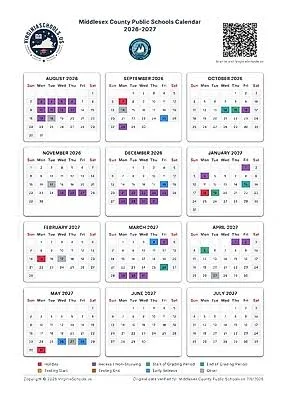
Public education along the lower Connecticut River is run by about a dozen separate school systems, not one county district, and each adopts its own calendar. Roughly 20,000 students attend public schools in the fifteen towns of the county, from Middletown, the largest, to small shoreline and river communities like Chester and Deep River. Because each town or regional district sets its own dates, two families in the same county can have different first days, February breaks, and graduation dates.
School District Structure in Middlesex County
Connecticut abolished county government in 1960, so Middlesex County has no county school board, no county superintendent, and no countywide calendar. Public schools are organized by town or by regional school district, and each is governed by its own elected Board of Education.
Districts serving Middlesex County towns include:
- Middletown Public Schools, governed by the Middletown Board of Education, the county’s largest district, with Middletown High School, Woodrow Wilson Middle School, and Keigwin Middle School among its schools
- Cromwell Public Schools, under the Cromwell Board of Education
- Portland Public Schools, under the Portland Board of Education
- East Hampton Public Schools, under the East Hampton Board of Education
- East Haddam Public Schools, whose high school is Nathan Hale-Ray High School
- Clinton Public Schools, whose high school is Morgan School
- Westbrook Public Schools and Old Saybrook Public Schools, on the shoreline
- Regional School District 4, serving Chester, Deep River, and Essex, with Valley Regional High School
- Regional School District 13, serving Durham and Middlefield, with Coginchaug Regional High School
- Regional School District 17, serving Haddam and Killingworth, with Haddam-Killingworth High School
Each district has its own central office, superintendent, and board meeting schedule. Most boards meet once or twice a month in the evening, and agendas and minutes are public. Regional boards include members from each member town, so a Region 4 or Region 13 calendar covers every school in the region at once. Vinal Technical High School in Middletown belongs to the state’s Connecticut Technical Education and Career System and keeps its own calendar, which usually runs close to the local districts’ but is not identical.
The county is a mix of settings. Middletown is a small city with a downtown and a Wesleyan University presence. Cromwell and Portland are suburban. The Haddam, Killingworth, East Haddam, and Durham areas are rural and wooded, with long bus routes. The shoreline towns of Old Saybrook, Westbrook, and Clinton are coastal and busy in summer. That mix affects bus schedules, school start times, and how fast a district can decide on a weather closure.
Academic Calendar Structure
Most Middlesex County districts start in the last week of August or just before Labor Day, and end in mid-to-late June, depending on how many weather days were used. Each district posts its own first and last day, and districts generally adopt the following year’s calendar by late winter or spring. Exact dates are not reliably the same from year to year, so check your own district’s current calendar.
Most elementary schools divide the year into trimesters, while middle and high schools more often use quarters or semesters, though practice varies by district. Report cards and progress reports usually follow those grading periods, and the first half of the year typically ends in late January.
Typical start and dismissal times vary by building. Elementary schools commonly run from about 8:30 or 9:00 a.m. to mid-afternoon. Middle schools and high schools run earlier, with high schools often starting around 7:30 to 8:00 a.m. Rural regional districts like Region 13 and Region 17 build schedules around bus routes covering multiple towns, so check your child’s school for exact bell times.
School Holidays and Breaks
Middlesex County districts typically observe the following, with exact dates set each year:
- Labor Day, either just before or just after the school year begins
- Columbus Day / Indigenous Peoples’ Day, in October
- Veterans Day, which some districts observe
- Thanksgiving break, usually Wednesday or Thursday through Friday
- Winter break, typically about ten days around Christmas and New Year’s Day
- Martin Luther King Jr. Day, in January
- February vacation, a week in mid-February that is often tied to Presidents’ Day, which is common in Connecticut
- Good Friday, observed by many Connecticut districts, a state holiday
- Spring break, usually a week in April
- Memorial Day and Juneteenth, depending on the calendar
Some districts also close for major religious holidays such as Rosh Hashanah and Yom Kippur, and some schedule an Election Day professional development day, since schools are often used as polling places. Dates move every year, so rely on the board-adopted calendar for the current year rather than last year’s.
If you are comparing calendars across Connecticut, the Middlesex County schools calendar and the Litchfield County schools calendar are good examples of how differently two Connecticut counties handle the same state rules. Both counties are made up of town and regional districts rather than one county system, but Middlesex’s shoreline and river towns and Litchfield’s hilltop northwest villages often end up with different start dates, February breaks, and weather-closure habits. Families moving between the two should check each town’s calendar and not assume the dates carry over.
How to Find the Official Calendar
The official calendar for your child is the one adopted by your district’s Board of Education, and it is posted on that district’s website. Start with the Middletown, Cromwell, Portland, East Hampton, East Haddam, Clinton, Westbrook, Old Saybrook, Region 4, Region 13, or Region 17 site, depending on where you live.
Boards generally vote on the next year’s calendar in the winter or spring, with the final version published as a PDF. Look under sections labeled “District,” “Parents,” “Families,” or “Community,” or search the site for “calendar.” Many districts also offer a subscribable digital calendar. Individual schools often keep their own pages for events like concerts, parent nights, and field trips, plus athletics, so the district calendar and a school’s page can show different things.
Early Release Days, Teacher Workdays, and Professional Development
Teachers report a few days before students in late August for planning and training. During the year, most districts schedule a small number of professional development days when students stay home, and some schedule regular early dismissal days for staff training. Connecticut requires each district to have a professional development and evaluation committee, which helps explain why these days are built into the calendar.
Families are normally notified through the district calendar, the school newsletter, and automated call, text, or email systems. Middletown’s larger schools tend to post many updates online, while smaller districts like Chester or Deep River may rely more on direct messages from the school. Because early release days affect childcare, check the calendar when it is first posted in spring so you can plan.
Emergency Closures and Weather Days
Closure decisions in Middlesex County are made by each superintendent, usually early in the morning after consulting town road crews and neighboring districts. Snow and ice are the usual causes. Hilly rural areas like Haddam, Killingworth, Durham, and East Hampton can have slick roads when Middletown and the shoreline are mostly clear, so one district may close or delay while another stays open.
The shoreline has its own risk. Old Saybrook, Westbrook, Clinton, and the river towns can face flooding and storm surge during tropical storms and nor’easters, and past hurricanes have closed schools there for days. Power loss can also close a school even when roads are clear.
Most districts announce closures and delays through an automated call, text, or email system and on their websites and social media. Connecticut television stations including NBC Connecticut, WFSB Channel 3, WTNH Channel 8, and FOX61 carry school closing lists, and local news sites also post updates. Sign up for your district’s alerts at the start of the year so you hear before the bus arrives.
Connecticut requires 180 school days, so districts usually build several snow days into the calendar and add days at the end of June when those are used up. Boards can also ask the state about relief after major emergencies. The result is that the last day of school in Middlesex County often moves after a snowy winter.
Graduation and End-of-Year Schedule
Final exams for high school students usually come in the last week or two of June or, in schools with semester exams, in January and June. Graduation for most Middlesex County high schools falls in mid-to-late June, usually on a weekend or an evening. Some schools hold commencement on their own football field or gym, and others use an outdoor or off-campus venue, with a rain location.
Elementary and middle schools hold promotion or moving-up ceremonies in the last week or so of school. Final report cards are posted through each district’s parent portal or sent home, and most districts keep portal access open over the summer so families can see final grades.
Back-to-School and Registration
New students should contact their district’s central office or school registration page in the spring or summer, since there is no countywide enrollment office. Districts typically ask for:
- proof of residency, such as a lease, mortgage statement, or utility bill
- the child’s birth certificate or other proof of age
- immunization records
- a recent health assessment, as Connecticut requires these for students entering school and at certain later grades
- records or transfer information from the prior school
A child must be five years old on or before January 1 to start kindergarten in Connecticut. School supply lists are usually posted on school websites in the summer, and many schools offer open houses, orientation days, or meet-the-teacher events in late August, which show up on school calendars.
Special Programs and Their Calendar Implications
Calendar differences are not limited to the main districts. Vinal Technical High School in Middletown follows the Connecticut Technical Education and Career System, so its holidays and early dismissals may differ from a student’s home district. Students in dual enrollment or early college courses through Middlesex Community College in Middletown or similar programs may need to follow the college’s schedule, which does not match the K-12 calendar, especially around breaks.
Preschool and pre-K programs, including state-funded School Readiness programs, may use a different calendar from the K-12 schedule or run on a different bus schedule. Districts that offer alternative or credit-recovery programs, including online options, may schedule them separately, so ask your school counselor for current dates. Private schools in the county, such as Xavier High School in Middletown, set their own calendars and are not bound by the public district schedule.
Athletics and Extracurricular Context
High school sports in Connecticut are governed by the Connecticut Interscholastic Athletic Conference (CIAC), which sets season dates, eligibility, and postseason tournaments. Many shoreline and river-valley schools compete in the Shoreline Conference, while Middletown High School and others compete in different leagues. Fall sports practice usually begins before the first day of school in late August, and playoffs and state tournaments can fall near breaks and exam periods. Some teams practice during February or spring vacations, so check your coach’s schedule as well as the district calendar.
State Requirements and How Connecticut Law Shapes the Calendar
Connecticut law requires local boards to provide at least 180 days of school each year, and also sets minimum instructional hours for a full school day. The Connecticut State Department of Education oversees these requirements, and the State Board of Education can approve exemptions in unusual circumstances. Local boards have wide discretion over the rest: when school starts and ends, how breaks are placed, how many days are used for professional development, and which holidays to observe. That is why a calendar in Old Saybrook may look different from one in Middletown, even though both meet the same state minimums.
Because Connecticut has no county school system, the state sets the minimum rules, each town or region adopts its own calendar, and parents should look to their own board.
Frequently Asked Questions
When does school start in Middlesex County, Connecticut?
Most districts start in late August or just before Labor Day. Each district sets its own date, so check your district’s current calendar.
When does school get out for summer in Middlesex County?
Usually mid-to-late June. A snowy winter can push the last day later, since lost days are made up at the end of the year.
How many days are in a school year?
Connecticut requires 180 days, and districts schedule their calendars to meet that number.
How do I find out if school is cancelled today?
Check your district’s alert system, its website and social media, and local television news such as NBC Connecticut, WFSB, WTNH, and FOX61. Sign up for alerts in advance.
What is the spring break schedule?
Most districts take a week in April, often near Good Friday, and many also have a week-long February vacation. Dates differ by district.
How do I enroll my child?
Contact your town or regional district’s central office or registration page. You will typically need proof of residency, a birth certificate, immunization records, and a health assessment.
Are there any year-round schools in Middlesex County?
Public schools in the county follow a traditional calendar with a summer break. Some districts offer summer programs or extended-year services for particular students.
Who do I contact about calendar questions?
Start with your school’s main office, then your district’s central office. Board of Education meetings are public, and the calendar is usually discussed and voted on there.
One Comment