Litchfield County connecticut schools calendar
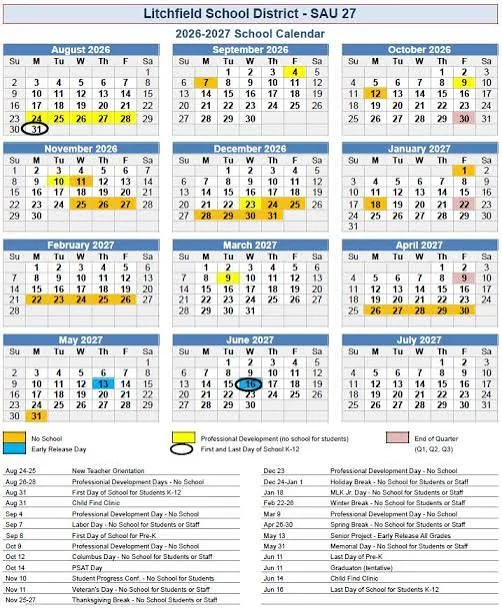
Roughly 25,000 students attend public schools across Connecticut’s northwest corner, spread over more than twenty small town and regional districts, and none of them answers to a county board. Connecticut eliminated county government in 1960, so each town or regional district in Litchfield County writes its own calendar. In a hilly, rural region with the state’s longest bus routes and heaviest snowfall, those calendars are shaped far more by winter weather and distance than by anything happening in Hartford or along the coast.
School District Structure in Litchfield County
Litchfield County is a geographic region of Connecticut, not an administrative one. The borough of Litchfield and the town of Litchfield share a name with the county, but there is no county commission and no county school board. Public education is run by town and regional boards of education, each led by a superintendent and each responsible for its own budget, calendar, and policies. The county is largely rural, with a few small cities such as Torrington and New Milford, and many towns with only a few thousand residents, so many districts share superintendents or join together in regional systems.
Districts serving the county’s 26 towns include:
- Torrington Public Schools, the largest district in the county, serving the city of Torrington
- New Milford Public Schools, serving the southern part of the county
- Watertown Public Schools and Thomaston Public Schools, with Thomaston part of Regional School District 6 alongside other nearby towns, depending on grade level
- Litchfield Public Schools, Bethlehem Public Schools, Woodbury Public Schools, Washington Public Schools, and Morris Public Schools, with several of these joining regional high school arrangements
- Regional School District 1 (Salisbury, Canaan, Sharon, Cornwall, Falls Village and neighboring towns, anchored by Housatonic Valley Regional High School)
- Regional School District 6 (Goshen, Warren, Morris)
- Regional School District 7 (Barkhamsted, New Hartford, and Winchester-area ties through Northwestern Regional High School in Winsted)
- Regional School District 10 (Burlington and Harwinton, with Burlington on the Hartford County side)
- Regional School District 12 (Washington, Roxbury, Bridgewater, with Shepaug Valley High School)
- Regional School District 14 (Woodbury and Bethlehem, with Nonnewaug High School)
- Regional School District 15 (Southbury and Middlebury, in neighboring New Haven County)
Regional district numbers and membership can be confusing, and several of the arrangements above cross county lines or change over time. The safest approach is to look up your address on your town’s website to confirm which board governs your child’s school. Regional boards are made up of members chosen by each member town, and most meet once or twice a month with agendas and minutes posted online. A search for “Litchfield schools” may bring up Litchfield Public Schools, which serves only that town, so check the town name before relying on a calendar.
Academic Calendar Structure
Connecticut has no single statewide start date, so Litchfield County districts typically open in late August or just after Labor Day and close in mid-to-late June. Boards usually adopt the next year’s calendar in winter or spring, and some publish two years at a time. Specific dates are not listed here because they change every year and differ across the county’s many systems.
Most districts use two semesters, with the first ending in January. Elementary schools often report by trimester or quarter, while middle and high schools commonly use quarters or semesters with midterms and finals. Check your district handbook for its grading periods.
Instructional time. Connecticut requires at least 180 days of actual school sessions, plus a minimum number of instructional hours for full-day students, about 900 for most grades. Because Litchfield County gets more snow than the shoreline, boards in the northwest hills often build several extra days into the calendar so the school year can still end in June.
Daily schedules. Bell times vary by town. Elementary schools commonly start between about 8:00 and 9:00 a.m. and dismiss between about 2:30 and 3:45 p.m. Middle and high schools often start between 7:30 and 8:15 a.m. Regional high schools that draw from several towns may begin earlier because of long bus routes, so confirm times with your child’s school.
School Holidays and Breaks
Litchfield County districts generally observe the following, with dates set by each board:
- Labor Day in early September
- Rosh Hashanah and Yom Kippur, which some districts close for or build into the calendar
- Columbus Day or Indigenous Peoples’ Day in October, depending on how the district names it
- Election Day in November, which some districts treat as a no-school day because schools serve as polling places
- Thanksgiving break, typically Wednesday through Friday, with some districts closing the full week
- Winter break, typically about ten days around Christmas and New Year’s Day
- Martin Luther King Jr. Day in January
- February break, often a full week around Presidents’ Day, which many families in this ski-and-snow region use for winter recreation
- Good Friday and spring break, usually in April
- Memorial Day in late May
- Juneteenth, a state holiday that some districts observe if it falls within the school year
Connecticut does not mandate a break pattern, so dates and names vary from district to district. Always rely on the board-adopted calendar, not last year’s version.
Families who live near county lines, or who are comparing towns before a move, often want to see how neighboring regions handle the same choices. The Hartford County schools calendar covers a central Connecticut area of cities and suburbs, where larger districts with magnet programs and more urban resources shape the school year, while the Litchfield County schools calendar covers a rural, hilly region in the northwest where small regional districts, long bus routes, and heavy snow drive scheduling. Reading the two side by side shows how much a district’s size and landscape affect start dates, storm plans, and the way each community builds its calendar.
How to Find the Official Litchfield County School Calendar
Start with the website of your child’s district, such as Torrington Public Schools, New Milford Public Schools, Watertown Public Schools, a regional district such as Regional School District 1, 6, 7, 12, or 14, or your own town’s school system. Calendars are usually posted as PDFs under headings such as “District,” “Parents,” “Families,” or “Community,” and many districts also add them to mobile apps and parent portals.
The board approves the calendar at a public meeting, which you can confirm in the agenda and minutes. If you cannot find it online, call the superintendent’s office or your child’s school. In small towns, a phone call often gets a faster answer than a website search. Individual schools may publish supplemental calendars for athletics, concerts, conferences, and parent organization events, but the district calendar governs attendance days.
Early Release Days, Teacher Workdays, and Professional Development
Teachers in Litchfield County return a few days before students for orientation, curriculum planning, and classroom setup. During the year, districts schedule professional development days when students stay home, and many also use early dismissal days so teachers can train or collaborate. Small and regional districts sometimes coordinate professional development days so shared staff, such as special education and music teachers, can attend sessions for each school they serve.
Connecticut law requires districts to provide ongoing professional development and sets mandatory training topics such as mandated reporting and suicide prevention. Boards decide how to schedule them, so early dismissal patterns differ from town to town. Parents who rely on after-school care should check early release days on the calendar and watch for email or text reminders.
Emergency Closures and Weather Days
Winter weather is the main reason for disruption in Litchfield County. The northwest hills, including Norfolk, Barkhamsted, Colebrook, and Cornwall, usually get more snow and colder temperatures than the rest of the state, and steep, winding roads, dirt roads, and long bus routes make decisions harder. Superintendents decide on closures, two-hour delays, and early dismissals, usually before dawn, after consulting town road crews, police, and bus contractors. Because conditions can differ sharply between a valley town and a hilltop town, neighboring districts do not always make the same call.
The county is inland, but storms can still cause problems. Tropical Storm Irene in 2011, the October 2011 snowstorm, and Tropical Storm Isaias in 2020 knocked out power to many Litchfield County towns, and flooding along the Housatonic and Naugatuck rivers can affect roads. Schools may close ahead of a storm, serve as shelters, or stay closed until power and roads are restored, with decisions guided by local emergency management officials.
For makeup days, state law requires districts to deliver 180 days. Districts build extra days into the calendar and extend the year into late June if needed, and the state education commissioner may grant relief in extraordinary circumstances. A few districts have used remote learning days instead of closures, so ask yours how snow days are counted.
How closures are announced. Districts send automated calls, texts, and emails and post alerts on their websites and social media accounts. Local and regional outlets that report closures include WFSB, NBC Connecticut, FOX61, WTNH, News 8, the Republican-American in Waterbury, the Register Citizen in Torrington, the News-Times, and regional radio stations. Make sure your school has your current phone number and email on file.
Graduation and End-of-Year Schedule
Final exams generally take place in the last week or two of the school year, with high school midterms in January and finals in June. Graduations are usually held in mid-June, often on school athletic fields or in gymnasiums, which in small towns makes them major community events. Weather backups are common, so check the rain plan. Elementary and middle schools may hold fifth-grade or eighth-grade promotion ceremonies in the final week or two.
Report cards are distributed at the end of each grading period, and most districts use online parent portals for grades and attendance. If you have not received a login, contact the school office.
Back-to-School and Registration Information
Re-enrollment for returning students typically opens in spring, and new students can register through the summer. Larger districts such as Torrington and New Milford may offer online registration or a central office, while small towns such as Norfolk, Warren, and Roxbury often handle registration through the school or superintendent’s office.
Families should expect to provide:
- Proof of residency, such as a lease, mortgage statement, or utility bill
- A birth certificate or other proof of age
- Immunization records, since Connecticut generally allows only medical exemptions for new enrollees
- A recent physical for students entering certain grades
- Prior school records if transferring
Supply lists are typically posted on school websites in summer. Open houses, back-to-school nights, and kindergarten orientations appear on school calendars.
Special Programs and Their Calendar Implications
Litchfield County has fewer magnet schools than the Hartford or Bridgeport areas, but several programs follow different calendars. Students interested in career and technical training may attend a Connecticut Technical Education and Career System school such as Oliver Wolcott Technical High School in Torrington, which follows a state-run calendar that can differ from the home district. Agriscience programs, including those at regional high schools in the county, may include summer or extended-year components.
Dual-credit and early college students may follow the calendars of Northwestern Connecticut Community College in Winsted, Naugatuck Valley Community College, Western Connecticut State University, or other partners. Preschool and School Readiness programs may run on different days or hours than K-12. Regional education service centers such as EASTCONN or CES support special education and other services for member districts, and those programs may have separate schedules. Online and alternative programs are arranged by the home district, so ask your school counselor.
Athletics and Extracurricular Calendar Context
High school sports in Connecticut are governed by the Connecticut Interscholastic Athletic Conference (CIAC), which sets seasons, classifications, and eligibility. Litchfield County schools compete in conferences such as the Berkshire League, the Naugatuck Valley League, and others. Many are small enough to compete in smaller CIAC classifications, and several teams are co-ops that combine students from more than one school. Athletic schedules are separate from the academic calendar but linked to it: practices and games continue during some breaks, state tournament play can overlap with exams, and eligibility is tied to grades. Winter sports schedules are often disrupted by snow, so check with the athletic department when weather threatens.
State-Level Calendar Requirements and How Connecticut Law Governs Litchfield County
The Connecticut State Department of Education (CSDE) oversees state education policy, and state statute requires at least 180 days of school with a minimum number of instructional hours. Local and regional boards of education have the authority to set start dates, breaks, holidays, and early release patterns, which is why a state with eight counties but no county governments still has well over a hundred school calendars.
For Litchfield County, that means a board must satisfy the 180-day requirement but can choose whether to start before or after Labor Day, how to handle religious observances, and how many storm days to build in. Regional districts must also coordinate with every member town, so their calendars often reflect compromises among communities. When extraordinary circumstances disrupt the year, districts may ask the state for relief, though most plan so they do not need to.
Frequently Asked Questions
When does school start in Litchfield County, Connecticut?
Most districts start in late August or just after Labor Day, but each town or regional district sets its own date. Check your district’s adopted calendar.
When does school get out for summer in Litchfield County?
Classes generally end in mid-to-late June, and storm days can push the last day later. Exact dates vary by district.
How many days are in a school year in Litchfield County?
Connecticut requires at least 180 days of school, and many Litchfield County districts schedule a few extra days as a buffer for snow.
How do I find out if school is cancelled today in Litchfield County?
Check your district’s automated call, text, or email alerts, its website and social media, and local TV stations such as WFSB, NBC Connecticut, FOX61, and WTNH. Call the district office if you are unsure.
What is the spring break schedule for Litchfield County schools?
Spring break usually falls in April and is often timed around Easter. Many districts also take a full week off in February.
How do I enroll my child in Litchfield County schools?
Register with the district for the town where you live, either at a central office, online, or at your child’s school. Bring proof of residency, a birth certificate, and immunization records.
Are there any year-round schools in Litchfield County?
Litchfield County districts follow traditional September-to-June calendars, though some summer and extended-year programs exist for specific students.
Who do I contact about school calendar questions in Litchfield County?
Contact the superintendent’s office or your child’s school in the town where you live, such as Torrington, New Milford, Watertown, or your regional district.
One Comment