Alameda County California Schools Calendar
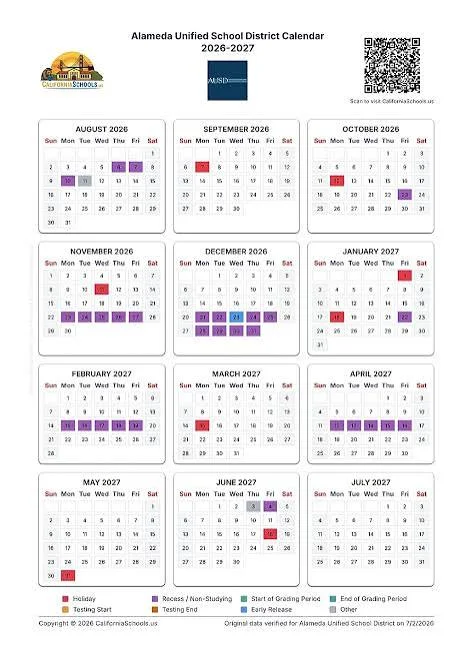
Roughly 200,000 public school students across the East Bay attend classes under more than a dozen separate school districts, which means there is no single calendar for the whole county. Oakland, Fremont, Berkeley, Livermore and every other community in between adopt their own schedules, and the differences can be as small as a few days or as large as a week of break. This guide explains how those calendars are built, who sets them, and where to find the one that applies to your child.
School District Structure in Alameda County
Alameda County is a large, mostly urban and suburban county on the east side of San Francisco Bay, with rural pockets in the Livermore Valley and the hills near Sunol. Public education is organized into independent school districts, each governed by its own elected Board of Education, and a county-level agency, the Alameda County Office of Education (ACOE), which supports the districts, oversees their budgets, and runs some special education and alternative programs.
The districts include Alameda Unified, Albany Unified, Berkeley Unified, Castro Valley Unified, Dublin Unified, Emery Unified, Fremont Unified, Hayward Unified, Livermore Valley Joint Unified, New Haven Unified in Union City, Newark Unified, Oakland Unified, Piedmont City Unified, Pleasanton Unified, San Leandro Unified, San Lorenzo Unified, and the single-school Sunol Glen Unified. Oakland and Fremont are among the largest, while Emery and Sunol Glen are among the smallest. Charter schools, which are public schools that may operate independently of the district they sit in, often follow their own calendars as well.
Unlike counties in Tennessee or Alabama, where a single county board runs the system, the county office here does not set the instructional calendar. Each district board adopts its own, normally at a public meeting held once or twice a month. Check your district’s website for the meeting schedule and the superintendent’s contact information, since leadership changes periodically.
Academic Calendar Structure
Most Alameda County districts start in mid-August, with a few starting in the days just before or after, and end in late May or early June. Berkeley, Oakland, and Fremont commonly open within a similar window, while some smaller districts shift by a few days. The exact first and last days are set when the board adopts the calendar, usually in the winter or spring before the new school year, and some districts approve two years at a time.
The standard structure is two semesters, with the fall semester ending in December or January and the spring semester running through the end of the year. Many elementary schools issue report cards on a trimester schedule, while middle and high schools often use semesters with progress reports in between. This varies by district and school, so check with your campus.
California requires districts to offer 180 instructional days, with state funding penalties for falling short, and also sets minimum instructional minutes by grade: 36,000 for kindergarten, 50,400 for grades 1 to 3, 54,000 for grades 4 to 8, and 64,800 for grades 9 to 12. Alameda County districts build their calendars to meet those totals. Bell schedules differ widely, but elementary schools in the county commonly begin between 8:00 and 8:45 a.m. and end between 2:30 and 3:15 p.m., with middle and high schools running somewhat later on the morning end. Many high schools in Berkeley, Oakland, and elsewhere have adjusted start times in recent years, so verify the current bell schedule for your child’s school.
School Holidays and Breaks
Alameda County districts follow a similar set of observances, although the specific days and which ones are included differ:
- Labor Day in early September
- Indigenous Peoples’ Day or Columbus Day in October, depending on district
- Veterans Day in November
- Thanksgiving break, usually several days
- Winter break, commonly two weeks around Christmas and New Year’s Day
- Martin Luther King Jr. Day in January
- Presidents’ Day, and in many East Bay districts a full mid-winter break in February
- Cesar Chavez Day on March 31, which some districts observe
- Spring break, typically one week in late March or April
- Memorial Day
- Juneteenth, which some districts include when it falls within the school year
California schools do not have a “fall break” in the Southern sense, but several Bay Area districts schedule a few days off in October or around Veterans Day. Because dates shift every year, rely on your district’s adopted calendar rather than a previous year’s.
How to Find the Official Alameda County School Calendar
The authoritative calendar is the one adopted by your district’s Board of Education. Find your district’s website, such as the Oakland Unified School District, Fremont Unified School District, Berkeley Unified School District, or Livermore Valley Joint Unified School District sites, and look under sections like District, Families, Parents, or Calendar. Most districts post a PDF that can be printed, plus a digital calendar that can be added to a phone.
If you are unsure which district serves your address, the Alameda County Office of Education and most district sites have address lookup tools. Individual schools publish their own pages with events, back-to-school nights, concerts, and sports. When there is a conflict between a school page and the board-adopted calendar, the adopted calendar governs days off and instructional days.
Families comparing how a very different region handles things, such as a rural Arkansas county with a handful of small districts, may find the Yell County schools calendar a useful contrast, and families already in the East Bay can return to the Alameda County schools calendar for the details that apply here.
Early Release Days, Teacher Workdays, and Professional Development
Teachers in Alameda County usually report a few days before students for planning, training, and classroom setup. California allows districts to count up to three staff development days toward the 180-day requirement, and many include one or more of these as pupil-free days during the year. Some districts also schedule collaboration time through early release or minimum days, most often weekly or monthly, so teachers can meet and plan. These are listed on the district calendar and announced through the district’s messaging system, school newsletters, and parent apps.
State-required training for staff, such as mandated reporter training and other safety topics, is typically handled during these workdays or online, so parents should expect a few days each year when campuses are open to staff only. Plan childcare early, since these days are not always the same across districts, particularly if you have children in more than one school.
Emergency Closures and Weather Days
Snow is not a factor in the East Bay, so weather closures here look different. The more common causes are wildfire smoke and poor air quality, extreme heat, heavy winter storms and flooding, power outages, and occasional earthquake damage along the Hayward Fault. Smoke events, in particular, have led districts to move recess indoors, cancel outdoor activities, or close campuses when the air quality index reaches unhealthy levels. The Bay Area Air Quality Management District publishes daily air quality readings that districts consult.
Closure decisions are made by the superintendent and district leadership, who weigh safety, staffing, and the condition of buildings and bus routes. Unlike in many states, California generally does not use built-in weather makeup days. Closed days that fall below the 180-day requirement can affect funding unless the state grants relief, so districts usually try to keep schools open when it is safe to do so.
Families are notified through automated calls, texts, and emails from the district, along with posts on district websites and social media accounts. Local television stations such as KTVU Fox 2, KRON 4, KPIX 5, ABC7, and NBC Bay Area also carry closure news when large events occur. Keep your phone number and email current in your school’s parent portal so alerts arrive.
Graduation and End-of-Year Schedule
Final exams at high schools are usually held in the last week before winter break or in January for the fall semester and again in late May or early June. Seniors often finish a few days before the rest of the school.
High school graduations in Alameda County typically take place in late May or early June, at campus football stadiums, gymnasiums, civic centers, or community college venues, with the location depending on district and class size. Elementary and middle schools often hold promotion or culmination ceremonies in the final days of school. Report cards are issued at the end of each grading period, and families generally view grades and attendance through online portals such as Aeries, PowerSchool, or Infinite Campus, depending on the district. Contact your school office if you need login help.
Back-to-School and Registration Information
Enrollment timing varies. Districts such as Oakland use a coordinated process with application windows in the winter for the following school year, while others accept neighborhood school registration in the spring and summer. Transitional kindergarten has expanded under state law to serve all four-year-olds, and kindergarten enrollment generally requires the child to be five on or before September 1.
Typical registration documents include:
- Proof of residency, such as a lease or utility bill
- Proof of the child’s age, such as a birth certificate
- Immunization records, which California requires for school entry
- Prior school records, if transferring
Most districts accept online registration, with in-person help at the district enrollment office or school. Supply lists are generally posted in the summer, and many schools host back-to-school nights or open houses in the first weeks of the year, which appear on school calendars.
Special Programs and Their Calendar Implications
Alameda County has a range of programs that may follow different schedules. High school students can take dual enrollment courses at nearby community colleges such as Chabot, Las Positas, Laney, Merritt, and Berkeley City College, and those classes follow the college calendar rather than the high school’s. Oakland Unified and other districts run magnet-style and career pathway programs that may have their own events and field work. Transitional kindergarten and state preschool programs may follow slightly different hours or start dates. The Alameda County Office of Education operates community school and special education programs with calendars that can differ from the local district.
Independent study and virtual options are available in several districts, and charter schools set their own calendars, often starting earlier or ending later. Nearly all traditional schools follow a standard August-to-June calendar, but families with children in specialty programs should check each program’s schedule directly.
Athletics and Extracurricular Calendar Context
High school sports are governed by the California Interscholastic Federation, and most Alameda County schools compete within its North Coast Section. Seasons are set by the CIF and section rules, and playoffs can extend beyond regular school dates. Practices, tournaments, and games sometimes occur during breaks, while exam weeks may limit scheduling. Local leagues, including the Oakland Athletic League, publish their own schedules, and each school’s athletics page is the best source for current dates.
State-Level Calendar Requirements and How California Law Governs Alameda County
The California Department of Education and the State Board of Education set the framework within which Alameda County districts design their calendars. State law sets the 180-day expectation, the minimum instructional minutes by grade, and the rules for how staff development days and minimum days count. Districts must also negotiate calendars with their teachers’ unions, which gives labor agreements a real role in how the final calendar looks. Local boards control most of the details, such as start and end dates, break placement, and early release patterns, so long as the state minimums are met.
Frequently Asked Questions
When does school start in Alameda County, California?
Most districts begin in mid-August, but start dates vary by district and by year. Check your district’s adopted calendar.
When does school get out for summer in Alameda County?
Most schools end in late May or early June, with seniors usually finishing earlier.
How many days are in a school year in Alameda County?
California requires 180 instructional days along with minimum instructional minutes, and Alameda County districts schedule their calendars to meet those requirements.
How do I find out if school is cancelled today in Alameda County?
Look for your district’s call, text, or email alert, check the district website and social media, and follow Bay Area TV stations. Closures are rare and are usually tied to smoke, power outages, or storms.
What is the spring break schedule for Alameda County schools?
Spring break is usually one week in late March or April, though the exact week differs by district.
How do I enroll my child in Alameda County schools?
Contact your district or local school, or use the district’s online registration or enrollment application, and provide proof of residency, proof of age, and immunization records.
Are there any year-round schools in Alameda County?
Most schools follow a traditional August-to-June schedule. A few charter or specialty programs may differ, so verify with the school.
Who do I contact about school calendar questions in Alameda County?
Contact your district’s central office or your child’s school. The Alameda County Office of Education can point you to the right district if you are unsure.
One Comment