Cook County Illinois Schools Calendar
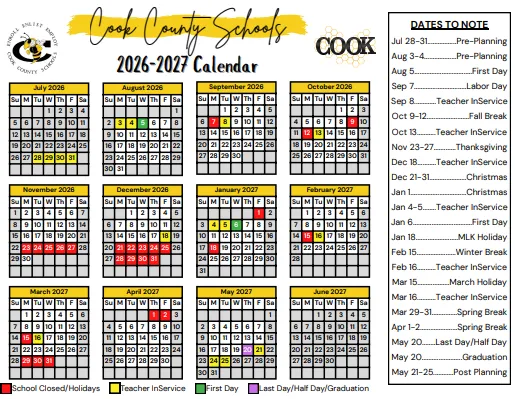
Cook County, Illinois is home to the largest concentration of public school students in the state, with well over 800,000 children enrolled across more than 100 separate school districts. Chicago Public Schools alone accounts for roughly 320,000 of them, while dozens of suburban elementary, high school, and unit districts fill in the rest of the county. That patchwork means there is no single Cook County calendar, and a parent in Evanston may see a very different schedule from one in Orland Park or Chicago Heights.
School District Structure in Cook County
Cook County is the clearest example in Illinois of fragmented school governance. Chicago Public Schools (City of Chicago School District 299) is the largest district, governed by the Chicago Board of Education, which has been transitioning from a mayor-appointed body to a fully elected board under state law. A chief executive officer leads daily operations, and the board meets on a monthly schedule with agendas and livestreams posted publicly.
Outside the city, the structure shifts. Illinois allows three types of districts, and Cook County has all of them. Unit districts serve kindergarten through twelfth grade, including Evanston/Skokie School District 65 (elementary) paired with Evanston Township High School District 202, Park Ridge-Niles feeder systems, Palatine, Arlington Heights, and Barrington-area districts. Large high school districts such as Township High School District 211 in Palatine and Schaumburg, District 214 in Arlington Heights, District 225 in Glenview and Northbrook, and Rich Township High School District 227 draw from multiple feeder elementary districts. Southern Cook County includes districts such as Bloom Township District 206, Homewood-Flossmoor District 233, and Thornton Township District 205. Each has its own elected seven-member Board of Education, and a superintendent who runs operations.
Because feeder elementary districts and the high school district they send students to adopt calendars independently, a family with a seventh grader and a ninth grader may deal with two different schedules. The Regional Office of Education for suburban Cook County, led by an elected Regional Superintendent, handles compliance, licensing, and truancy support but does not set calendars. Cook County is overwhelmingly urban and suburban, with dense transit access in Chicago and long suburban bus routes in the outer townships, and both factors shape start times and weather decisions.
Academic Calendar Structure
Most Cook County districts begin classes in mid to late August, and Chicago Public Schools has typically opened in the latter half of August in recent years. Suburban districts commonly start a few days earlier or later than CPS depending on local contracts. The school year generally ends in early to mid June in Chicago and late May to early June in most suburbs. The exact first and last days are set each year by each board, so check the adopted calendar rather than relying on last year’s dates.
The first semester typically closes in January for high schools, often just after winter break, with the second semester running through spring. CPS elementary schools use quarter-based reporting, while many suburban high schools use semesters with quarter progress reports, and some elementary districts report on a trimester basis.
Illinois requires at least 176 student attendance days and five clock hours of instruction in a full day. CPS and many suburban districts schedule close to 176 to 180 days, depending on how institute days and emergency days are counted. School day hours vary widely in Cook County. Chicago elementary schools often run from early morning through mid-afternoon with different start times set by each school, while suburban high schools like those in Districts 211 and 214 generally start between 7:30 and 8:30 a.m. and end by mid-afternoon. Confirm bell times with your child’s school, because they are set building by building.
School Holidays and Breaks
Cook County districts generally observe the following, with dates set annually:
- Labor Day in the first week of September
- Indigenous Peoples’ Day or Columbus Day in October, which Chicago and many suburbs treat differently
- A fall break or parent-teacher conference days in October or November in some districts
- Thanksgiving break, usually Wednesday through Friday or the full week
- Winter break of about two weeks around Christmas and New Year’s Day
- Martin Luther King Jr. Day in January
- Lincoln’s Birthday and Pulaski Day, which Illinois recognizes and some districts use as days off
- Presidents’ Day in February
- Spring break in late March or early April, often one week
- Memorial Day, which usually falls just before the last days of school
Chicago Public Schools has also observed Election Day as a non-attendance day in some years, and some suburban districts do the same. These dates shift every year, and the district’s adopted calendar is the only reliable source.
How to Find the Official Cook County School Calendar
Because Cook County has so many districts, start by identifying your address’s elementary and high school districts. The Illinois State Board of Education’s school finder tool and your property tax bill both identify the correct districts. Chicago Public Schools posts its calendar at cps.edu, and suburban districts post theirs on their own sites under sections usually labeled “District,” “Parents,” or “Community.” Boards typically adopt next year’s calendar in the winter or spring after negotiating with teacher unions.
Individual schools publish supplemental calendars for concerts, athletics, and parent nights. If the school’s page and the district page conflict, rely on the board-approved district version.
For families comparing options across central and northern Illinois, the coles county schools calendar shows how a smaller unit-district region handles dates, while the cook county schools calendar page helps you sort through the many separate districts here and find the one that matches your address.
Early Release Days, Teacher Workdays, and Professional Development
Teachers return before students for institute days and workdays in August. Throughout the year, many Cook County districts schedule non-attendance days for professional development, including mandatory teacher training on topics tied to Illinois license renewal. Chicago Public Schools uses a mix of full non-attendance days and school-level planning time, while suburban districts like District 211 and District 214 often schedule late starts or early dismissals for staff collaboration.
Families usually learn about early release days through the district calendar, parent portal, email, text alerts, and school newsletters. Chicago families should check both the district and school-level calendars, since individual schools may adjust bell schedules.
Emergency Closures and Weather Days
Winter storms and extreme cold, including lake-effect snow and wind chills off Lake Michigan, are the main reasons for closures in Cook County. Chicago Public Schools has generally been reluctant to close but has done so during severe storms and dangerous cold, and decisions come from the CEO’s office in consultation with city agencies. Suburban superintendents decide for their own districts, often by early morning, after consulting road crews and transportation staff.
Illinois allows districts to use emergency days, and many Cook County districts build days into the calendar or extend the year if needed. Some also use remote or e-learning days under approved plans. Closures are announced through automated calls, texts, district websites, and social media. Local media include WGN, WLS-ABC 7, WBBM-CBS 2, WMAQ-NBC 5, WFLD-FOX 32, and radio stations such as WBBM Newsradio 780 and WGN Radio. Chicago Tribune and Chicago Sun-Times also carry closure lists. Spring severe weather can trigger early dismissals or shelter-in-place protocols.
Graduation and End-of-Year Schedule
Final exams in Cook County high schools typically take place in the last week or two of the year, often in January and again in late May or early June. Graduation ceremonies generally occur in late May or June. Larger districts sometimes use venues beyond the school itself, such as college campuses or large arenas, while smaller schools hold ceremonies in their own gymnasiums or stadiums. CPS high schools hold their own ceremonies across the city in late spring.
Elementary and middle school promotion ceremonies are held at individual schools near the end of the year. Report cards are distributed on the last day or released through online parent portals, such as CPS’s family portal and the platforms used by suburban districts.
Back-to-School and Registration Information
Enrollment generally opens in the spring for the following year, with CPS operating a centralized application process for selective and magnet programs and neighborhood school enrollment handled at the school level. Suburban districts typically use online registration portals that open in spring or summer.
Families should be ready with proof of residency, a birth certificate, and immunization and physical exam records that meet Illinois requirements. Illinois also requires proof of eye exams for first-time enrollees in kindergarten and dental exams in specific grades. School supply lists are usually posted in July, and meet-the-teacher events or open houses are held the week before classes begin.
Special Programs and Their Calendar Implications
Cook County has an unusually wide range of specialty options. Chicago Public Schools operates selective enrollment, magnet, and charter schools, and some follow slightly different calendars or application timelines. Suburban districts offer career academies, such as those run by Districts 211 and 214, and students may travel between campuses for part of the day.
Dual credit programs with City Colleges of Chicago, Harper College in Palatine, Oakton College in Des Plaines, Moraine Valley Community College in Palos Hills, and others may follow the college’s calendar rather than the high school’s. Pre-K and early childhood programs, including Chicago’s expanding early learning options, may follow separate hours and start dates. Alternative schools and virtual options are available through districts and approved providers, and they may have their own deadlines and breaks.
Athletics and Extracurricular Calendar Context
Athletics and activities are governed by the Illinois High School Association (IHSA). Teams compete in conferences such as the Chicago Public League, the Mid-Suburban League, the Central Suburban League, and the South Suburban Conference, and schedules are separate from the academic calendar. Football practice begins before the first day of school, winter sports run through the holiday break, and spring sports finish with state tournaments in May and early June. Exam weeks can limit practices, so check with your athletic director.
State-Level Calendar Requirements and How Illinois Law Governs Cook County
The Illinois State Board of Education (ISBE) administers the School Code, including the 176-day attendance minimum and five-hour full-day requirement. State law also governs institute days, state holidays, and emergency day rules. Local boards in Cook County set start and end dates, break lengths, and the use of institute and early release days within those limits, and collective bargaining agreements with teacher unions can influence calendar design, including the Chicago Teachers Union’s contract with CPS.
Frequently Asked Questions
When does school start in Cook County, Illinois?
Most districts begin in mid to late August. Chicago Public Schools and suburban districts set their own dates, so check your district’s adopted calendar.
When does school get out for summer in Cook County?
Suburban districts generally finish in late May or early June, and CPS usually ends in June. Weather makeup days can extend the year.
How many days are in a school year in Cook County?
Illinois requires at least 176 pupil attendance days, and Cook County districts typically schedule between 176 and 180.
How do I find out if school is cancelled today in Cook County?
Watch for your district’s call, text, or email, check its website and social media, and tune in to WGN, WLS, WBBM, WMAQ, or WFLD.
What is the spring break schedule for Cook County schools?
Spring break is usually one week in late March or early April, with dates set by each district. CPS and many suburbs do not always align.
How do I enroll my child in Cook County schools?
Identify your district using your address, then register through the district’s online portal or school office with proof of residency, a birth certificate, and health records.
Are there any year-round schools in Cook County?
Most schools follow a traditional August-to-June calendar, though a small number of Chicago schools have used extended or modified calendars.
Who do I contact about school calendar questions in Cook County?
Contact your district’s central office or your child’s school. For state-level questions, the Regional Office of Education for suburban Cook County or ISBE can help.
One Comment