Fairbanks North Star Borough Alaska Schools Calendar
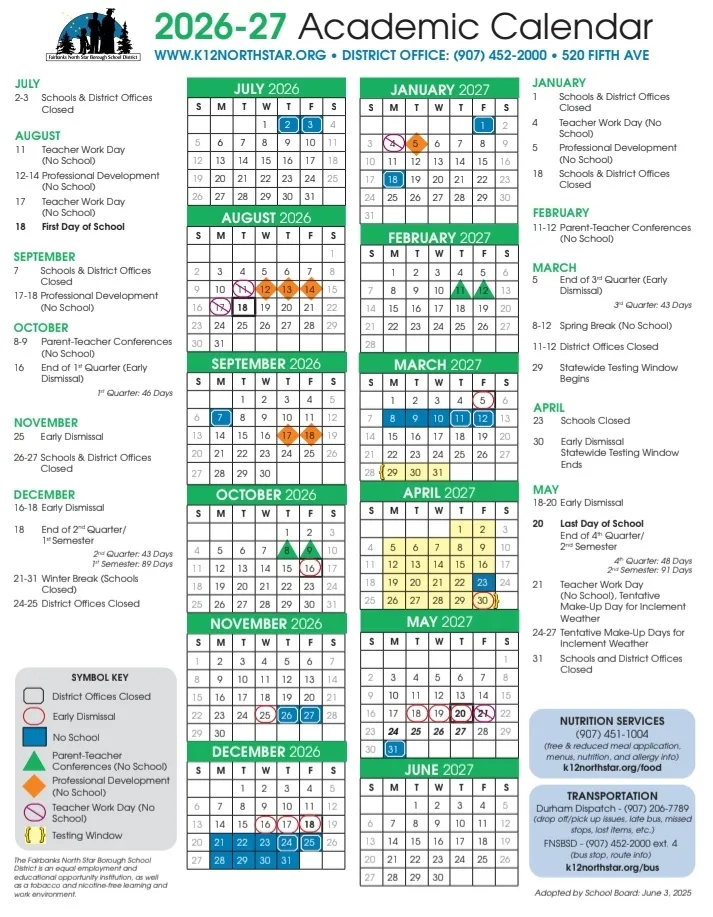
Roughly 12,000 students attend public school in the Fairbanks North Star Borough School District, the largest school system in Alaska’s Interior and one of the biggest in the state. Its calendar has to account for a subarctic climate where winter temperatures regularly fall far below zero, a daylight cycle that swings from nearly 24 hours of sun in June to under four hours in December, and a community that includes a university, a major military presence at Fort Wainwright and Eielson Air Force Base, and small settlements along the Richardson and Steese highways. Families here deal with a calendar that is more structured and more urban than the ones used in most of rural Alaska.
School District Structure in the Fairbanks North Star Borough
Alaska has no counties. Its organized local governments are boroughs, and the Fairbanks North Star Borough is a second-class borough that includes the cities of Fairbanks and North Pole along with unincorporated communities such as College, Ester, Fox, Goldstream, and Salcha. Unlike the Unorganized Borough, which has no borough government, this borough has an assembly and a mayor, and it is responsible by state law for operating public schools in its area.
Public education is delivered by a single district, the Fairbanks North Star Borough School District, commonly shortened to FNSBSD. It is governed by the Fairbanks North Star Borough Board of Education, an elected board that sets policy, adopts the budget request, and approves the annual calendar. The board hires the superintendent, whose central office is in downtown Fairbanks. The borough assembly provides local funding, so the calendar and the budget are closely linked. The board holds regular public meetings, usually twice a month during the school year, and publishes agendas in advance. Verify the current meeting schedule on the district website.
The borough is mostly a mix of urban and suburban areas around Fairbanks and North Pole, with rural pockets stretching outward. That mix explains why the district operates a large number of neighborhood elementary schools, several middle and high schools, and a handful of alternative and charter programs, rather than the few small campuses found in remote boroughs.
Academic Calendar Structure
FNSBSD typically begins classes in mid-August and wraps up in late May. This is earlier than most of the country, partly because Alaska districts build their calendars around long winter breaks and a relatively early finish. The district usually approves the following year’s calendar in the winter or spring, and sometimes adopts a multi-year draft, so check the district website for the current version rather than relying on a prior year’s dates.
The year is organized into two semesters. The fall semester runs from the August start to a break in mid-December, and the spring semester picks up in January and continues to the end of the school year. Secondary schools report grades by quarter, and elementary schools generally issue report cards on a trimester or quarter schedule, so confirm which applies to your child’s school.
Alaska law sets the minimum school term at 180 days, and state regulations also require minimum instructional hours by grade level. FNSBSD builds a student calendar that satisfies both requirements and adds staff in-service days on top. Because the district is large, it has the flexibility to schedule early release days within the instructional hours rather than adding days.
Start and end times vary by school level and have changed over the years as the district adjusts bus routes and budgets. Elementary, middle, and high schools do not all start at the same hour, and some neighborhood schools differ. Look up your own school’s bell schedule on its page or call the office.
School Holidays and Breaks
The district follows the standard American holiday pattern, with a few Alaska-specific additions.
- Labor Day: The first Monday in September.
- Fall break: FNSBSD has often scheduled a long weekend in October. Confirm whether the current calendar includes one.
- Thanksgiving break: Usually Wednesday or Thursday through Friday, sometimes a full week.
- Winter break: Typically about two weeks around Christmas and New Year’s Day.
- Martin Luther King Jr. Day: The third Monday in January.
- Presidents’ Day: A February holiday, sometimes combined with other days.
- Seward’s Day: An Alaska holiday on the last Monday in March, which some years falls near spring break.
- Spring break: Usually a week in March or early April.
- Memorial Day: The last Monday in May.
Exact dates move every year. The calendar adopted by the Board of Education is the only dependable source for the current school year.
Families who compare how Alaska districts schedule their years may find it useful to read the Fairbanks North Star Borough schools calendar alongside the Dillingham Census Area schools calendar. One serves a large Interior hub and the other a remote, roadless region, and the differences show up in start dates, breaks, and how each handles weather and travel.
How to Find the Official Fairbanks North Star Borough School Calendar
The authoritative calendar is posted by the Fairbanks North Star Borough School District on its official website, usually in a section labeled “District,” “Parents,” or “Community.” A PDF version is normally available for printing, and some versions can be added to a phone or computer calendar. The Board of Education adopts calendars at a public meeting, and the approved document appears on the site soon afterward.
Individual schools publish their own supplemental calendars for concerts, conferences, open houses, and athletic events. High schools in particular maintain separate activity calendars. Use both the district calendar and the school calendar when planning around work and family travel.
Early Release Days, Teacher Workdays, and Professional Development
Teachers report several days before the first student day for planning, training, and classroom setup. Throughout the year, the district schedules in-service days when students are not in attendance, often grouped around the end of a quarter or semester so teachers can use them for grading and training. Alaska requires districts to provide ongoing professional development, and the district builds that into its in-service schedule.
Early release days are more common here than in small rural districts. They are typically used for staff training and collaboration and are announced in the school calendar, in school newsletters, and through the district’s parent messaging system. Families who rely on after-school care should check the calendar early in the year so they can plan for shortened days.
Emergency Closures and Weather Days
Fairbanks is known for extreme cold, and that shapes the district’s closure decisions. The district generally keeps schools open in heavy snow because snow is routine and the roads are well maintained. The more common issues are very low temperatures that affect bus operation and student safety, ice fog, freezing rain, and the occasional wildfire smoke event in summer or early fall. The superintendent makes the call after consulting transportation staff, road conditions, and weather forecasts, usually early in the morning. Cold-weather guidelines tied to temperature and wind chill may govern outdoor recess and bus operations, and the district publishes related guidance.
Closures and delays are announced through the district website, its automated phone, text, and email notification system, and social media. Local media also carry announcements, including KTVF (NBC), KATN (ABC), KUAC public radio, and the Fairbanks Daily News-Miner. Make sure your contact information is up to date in the district’s parent portal so alerts reach you.
For lost instructional time, the district may add days to the end of the school year, use buffer days if the calendar includes them, or in some circumstances seek relief under state rules. The adopted calendar and board policy spell out the specifics.
Graduation and End-of-Year Schedule
Final exams for high school students typically take place in the last week or two before the end of each semester. Graduation ceremonies for the borough’s high schools are generally held in May, and venues often include school gymnasiums or larger community facilities, including space on the University of Alaska Fairbanks campus. Elementary and middle school promotion events are usually scheduled in the final week of classes and are announced by individual schools.
Report cards are issued at the end of each grading period. Parents and students typically use an online student information portal to view grades, attendance, and assignments, and the school office can help with account setup.
Back-to-School and Registration Information
Enrollment and re-enrollment generally open in the spring or early summer. New families can usually register through the district’s online enrollment process or at the school they plan to attend. Bring the following:
- Proof of residency in the Fairbanks North Star Borough
- A birth certificate or other proof of age
- Immunization records or a documented exemption allowed by Alaska law
- Prior school records, if available
Military families moving to Fort Wainwright or Eielson Air Force Base should ask the school or the military liaison about transfer procedures and timing, since orders often arrive late in the summer. School supply lists are usually posted on school websites in the summer, and most schools hold an open house, meet-the-teacher event, or back-to-school night near the start of the year. These dates appear on school calendars.
Special Programs and Their Calendar Implications
FNSBSD offers a number of options beyond neighborhood schools, including charter and optional programs, language immersion and focused academic programs, and alternative secondary programs. These programs generally follow the district calendar, but some may have different schedules for field trips, conferences, or program-specific events, so check with the school directly.
Dual enrollment and early college options are available through the University of Alaska Fairbanks and other partners, and those courses follow university semester dates, which may not match district breaks. Pre-K availability varies by site and funding. The district also supports distance and correspondence options, and Alaska’s statewide correspondence programs follow their own calendars. If your child will be in a program that does not follow the standard schedule, ask the program office for its calendar.
Athletics and Extracurricular Calendar Context
High school athletics in Alaska are governed by the Alaska School Activities Association (ASAA), which sets seasons, eligibility rules, and state tournament dates. The borough’s high schools compete locally and travel to Anchorage, the Mat-Su Valley, and elsewhere for some events, so travel and missed class time can be significant. Seasons sometimes overlap with exam periods, early release days, or breaks, particularly in winter and at the end of the year. Check the school’s activity calendar alongside the academic one.
State-Level Calendar Requirements and How Alaska Law Governs the Fairbanks North Star Borough
The Alaska Department of Education and Early Development (DEED) oversees public schools statewide and sets the minimum standards for the school term. State law requires at least 180 days of instruction, and DEED regulations set instructional hour minimums by grade level. Within those limits, local boards such as the Fairbanks North Star Borough Board of Education have broad discretion over start and end dates, holidays, and breaks. Because the borough funds a significant share of the district’s budget, the borough assembly also has influence over how many days and hours the district can afford to operate.
Frequently Asked Questions
When does school start in the Fairbanks North Star Borough, Alaska?
Usually in mid-August. The exact date is set by the Board of Education and posted on the district website.
When does school get out for summer in the Fairbanks North Star Borough?
Typically in late May. Check the adopted calendar for the exact last day.
How many days are in a school year in the Fairbanks North Star Borough?
Alaska requires at least 180 days, and the district also has to meet the state’s minimum instructional hours.
How do I find out if school is cancelled today in the Fairbanks North Star Borough?
Check the district website and social media, watch for text, phone, or email alerts, and tune in to KTVF, KATN, or KUAC. The Fairbanks Daily News-Miner website may also carry updates.
What is the spring break schedule for Fairbanks North Star Borough schools?
Spring break usually falls in March or early April and lasts about a week. The adopted calendar lists the exact dates.
How do I enroll my child in Fairbanks North Star Borough schools?
Use the district’s online enrollment process or contact the school your child will attend. Bring proof of residency, a birth certificate, and immunization records.
Are there any year-round schools in the Fairbanks North Star Borough?
The district runs a traditional August-to-May calendar at most schools. Ask the district whether any program follows a different schedule.
Who do I contact about school calendar questions in the Fairbanks North Star Borough?
Start with your child’s school office or the Fairbanks North Star Borough School District central office. For policy questions, contact the Board of Education.