Sonoma County California Schools Calendar
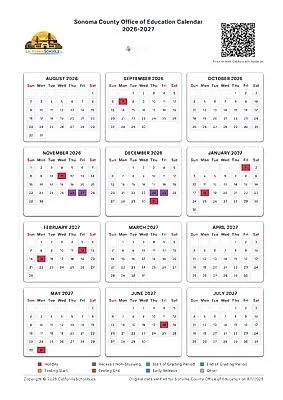
About 70,000 students attend public schools in Sonoma County, California, a North Bay county of wine country, redwood forests, and Pacific coastline where roughly 40 school districts, from the large Santa Rosa City Schools to small rural and coastal systems, each adopt their own calendars. There is no countywide schedule, so a family in Petaluma, one in Healdsburg, and one in Gualala can share a county without sharing a first day of school, a spring break, or a wildfire evacuation plan.
School District Structure in Sonoma County
Sonoma County is a county in the legal sense, with Santa Rosa as its county seat, but its schools are run by locally elected governing boards rather than by the county. The Sonoma County Superintendent of Schools leads the Sonoma County Office of Education (SCOE), overseen by the elected Sonoma County Board of Education. SCOE provides special education services, county community schools, career technical programs, fiscal oversight, and training support for districts, but it does not set local calendars.
The county uses a mix of structures, and many households live in an elementary district that feeds a separate high school district. Santa Rosa City Schools operates as a combined system for the city of Santa Rosa, with its own elementary and high school districts under one administration. Petaluma City Schools serves Petaluma in a similar way. Other high school districts include Healdsburg Unified, Cloverdale Unified, Windsor Unified, Sonoma Valley Unified, Cotati-Rohnert Park Unified, West Sonoma County Union High School District (serving Sebastopol, Forestville, and nearby communities), and Analy and El Molino high schools within it. Many elementary districts feed these high schools, including Bellevue Union, Piner-Olivet Union, Mark West Union, Rincon Valley Union, Roseland, Gravenstein Union, Twin Hills Union, Dunham, Liberty, Waugh, Wright, and Kenwood, among others. On the coast, Gualala-area students attend Point Arena Joint Union and Manchester-area schools in Mendocino County or Sonoma County coastal districts such as Fort Ross and Montgomery. Please rewrite this paragraph from SCOE’s current district list before publishing, because the county has many small districts and feeder relationships are easy to get wrong.
Boards generally meet once or twice a month, usually in the evening, with agendas posted in advance on district websites. The county blends urban and suburban neighborhoods in Santa Rosa, Petaluma, and Rohnert Park with vineyards, dairy and farmland, and remote coastal communities, so transportation and calendar needs vary. Families near district lines should confirm which district serves their address.
Academic Calendar Structure
Most Sonoma County districts start in mid-to-late August and end in late May or early June, though exact dates vary by district and year. Boards usually adopt the next year’s calendar in winter or spring, and some adopt two years at once, so district websites may show dates well ahead.
High schools use two semesters, with finals before winter break or in January depending on the district. Elementary schools commonly report progress by trimester, though some use semesters. Check your district’s grading calendar for precise end dates.
California requires 180 instructional days and sets minimum instructional minutes by grade level: 36,000 for kindergarten, 50,400 for grades one through three, 54,000 for grades four through eight, and 64,800 for grades nine through twelve. Sonoma County districts meet those totals through full-length days, with minimum days mixed in for conferences and grading periods.
Elementary bell times in Santa Rosa, Petaluma, and Rohnert Park generally fall between about 8:00 and 8:30 a.m. at the start and end in early-to-mid afternoon. State law bars middle schools from starting before 8:00 a.m. and high schools before 8:30 a.m., with limited exceptions such as optional zero periods. Confirm bell schedules on each campus’s page.
School Holidays and Breaks
Standard closures on Sonoma County district calendars usually include:
- Labor Day in early September
- Veterans Day on or near November 11
- Thanksgiving break, often a full week or most of it
- Winter break of about two weeks around Christmas and New Year’s Day
- Martin Luther King Jr. Day in January
- Presidents’ Day, sometimes with a February break
- Spring break, typically one week in late March or April
- Memorial Day in late May
Fall break of the Tennessee type is not standard. Many districts observe Cesar Chavez Day on March 31, which carries meaning in a county with a large vineyard and agricultural workforce, and spring break may or may not be tied to Easter. Holidays shift each year, so the adopted calendar is the only reliable source.
How to Find the Official Sonoma County School Calendar
Because no countywide calendar exists, begin by identifying the district that serves your address. SCOE’s website lists the county’s districts and links to each, which helps if you are new to the area or live near a boundary. Then visit the district site, such as Santa Rosa City Schools, Petaluma City Schools, or Windsor Unified, and look under “Calendar,” “District,” “Parents,” “Families,” or “Community.” Board-adopted calendars are typically posted as PDFs, and many districts offer a feed you can add to a phone or email calendar.
Calendars are approved at a public board meeting, with the agenda packet posted ahead of time, so you can see proposed dates before the vote. Individual schools keep supplemental calendars for back-to-school nights, concerts, picture days, field trips, and assemblies, and athletic schedules typically live on separate pages.
Families moving around the North Bay often want to compare how calendars work from one county to the next. If you are curious how a neighboring county of mostly unified districts handles it, you can read about the Solano County schools calendar, or return to the Sonoma County schools calendar overview here for wine country and coastal details.
Early Release Days, Teacher Workdays, and Professional Development
Teachers in Sonoma County typically report several days before students return in August for planning and training. During the year, pupil-free days are scheduled for professional development, grading, and parent conferences, often near the end of a semester or trimester.
Minimum days and early release days are common in elementary schools, particularly around grading periods, conferences, and holidays. Many families commute along Highway 101 to Marin County and the Bay Area, so early release days can strain child care, and families should plan ahead. Districts announce these through the annual calendar, school newsletters, and notification platforms by text, email, and phone, often in English and Spanish.
California requires certain staff training, including mandated reporter training, but does not set a fixed number of pupil-free days. Each district negotiates those days locally with its teachers’ association.
Emergency Closures and Weather Days
Snow is not a factor, so the main disruptors in Sonoma County are wildfire and smoke, flooding, power outages, extreme heat, and earthquakes. Wildfire has shaped recent school years more than any other hazard. The 2017 Tubbs Fire devastated parts of Santa Rosa, and later fires, including the Kincade Fire in 2019 near Healdsburg and Windsor and the Glass Fire in 2020, brought evacuations, extended closures, and poor air quality. Smoke can push air quality into unhealthy ranges and move recess and athletics indoors. Public Safety Power Shutoffs have also closed schools. Winter atmospheric river storms can flood the Russian River, especially around Guerneville, Healdsburg, and Cloverdale, and the county sits near the Rodgers Creek and San Andreas faults.
Closure decisions rest with the district superintendent, typically after consulting transportation staff and local fire and emergency officials. Notices go out through the district’s automated call, text, and email system, the district website, and social media. The county also uses an emergency alert system called SoCo Alert. Local outlets include The Press Democrat, the Petaluma Argus-Courier, the Sonoma Index-Tribune, the North Bay Business Journal, KSRO radio, KRON 4, KTVU Fox 2, KGO, and KPIX, along with Spanish-language outlets.
California does not require districts to make up every closure day as some states do, but districts must meet instructional day and minute requirements to receive full state funding. Significant closures may lead a district to request a waiver from the California Department of Education, which has been used after major wildfire emergencies. Ask your district how makeup time is handled.
Graduation and End-of-Year Schedule
High school finals usually fall in the last week or two before winter break or in January, and again in late May or early June, depending on the district’s semester structure. Graduations are generally held in late May or early June, often on school football fields or at larger local venues. Smaller high schools hold ceremonies on campus.
Elementary and middle schools hold promotion or moving-up ceremonies in the final week or so. Report cards are issued by trimester or semester, and families can usually check grades through a student information portal. If you do not have login credentials, contact the school office.
Back-to-School and Registration Information
Enrollment for the coming year commonly opens in the spring, often through an online process for returning students and a separate one for new families. Districts must enroll students who live within their boundaries, and many Sonoma County districts accept interdistrict transfer requests when space is available. Popular campuses in Petaluma, Sebastopol, and Sonoma may have capacity limits, so apply early.
Typical documents include proof of residency, a birth certificate or other proof of age, and immunization records. California does not permit personal belief exemptions, so check requirements with the school nurse or district office. Registration is generally online, with in-person help at district offices or school front desks.
Supply lists are usually posted in late summer on school websites. Orientations, open houses, and back-to-school nights tend to appear in the first weeks of the year. Transitional kindergarten is available to all four-year-olds statewide and generally follows the elementary calendar.
Special Programs and Their Calendar Implications
Several programs in the county may run on different schedules. Charter and specialty schools, including language immersion programs, set their own calendars, though many follow their sponsoring district’s major holidays. Alternative and continuation programs, along with SCOE’s court, community, special education, and career technical programs, may have different start dates or session lengths.
Dual enrollment and early college students need to follow two calendars. Santa Rosa Junior College, with campuses in Santa Rosa and Petaluma, and Sonoma State University in Rohnert Park run on college schedules whose finals and breaks do not always match local high school dates. Preschool and early childhood programs, including state preschool and Head Start, may follow different calendars from the K-12 districts. Independent study and virtual options are offered by several districts and charters, and each sets its own calendar, so confirm dates directly with the program.
Year-round calendars are uncommon in the county today, with traditional calendars dominating.
Athletics and Extracurricular Calendar Context
High school athletics in Sonoma County fall under the California Interscholastic Federation, North Coast Section (CIF-NCS), which sets season dates, eligibility rules, and playoff schedules. Local schools compete in leagues within that structure, such as the North Bay League and the Sonoma County League. Fall, winter, and spring sports do not always match the academic calendar, so football playoffs, basketball tournaments, and spring competitions can overlap with holidays and exam weeks. Teams sometimes practice during breaks. Smoke, storms, and fires can postpone events. Each school’s athletics page posts schedules separate from the academic calendar.
State-Level Calendar Requirements and How California Law Governs Sonoma County
The California Department of Education sets the framework. State law requires 180 instructional days and specifies minimum instructional minutes by grade level, but leaves districts wide latitude over start and end dates, break timing, and the mix of regular, minimum, and pupil-free days. State law also limits how early middle and high schools may begin, and employee bargaining agreements shape staff development days and early release schedules.
Sonoma County districts are funded based on attendance, though some basic-aid districts rely primarily on local property taxes, and all must stay in compliance with instructional requirements. The California Department of Education publishes guidance on waivers, minimum days, and emergency closures. Because the state leaves so much to local boards, a neighboring district’s calendar tells you little about your own.
Frequently Asked Questions
When does school start in Sonoma County, California?
Most districts begin in mid-to-late August. Exact first days vary by district and year, so check your district’s adopted calendar.
When does school get out for summer in Sonoma County?
Most schools end in late May or early June, with many high school graduations in the final week or two.
How many days are in a school year in Sonoma County?
Districts provide about 180 instructional days and also meet California’s minimum instructional minutes by grade level.
How do I find out if school is cancelled today in Sonoma County?
Check your district’s website and social media, watch for automated calls or texts, sign up for SoCo Alert, and follow The Press Democrat, KSRO, KRON 4, or KTVU.
What is the spring break schedule for Sonoma County schools?
Spring break is typically one week in late March or April. Each district sets its own dates, and some tie it to Easter while others do not.
How do I enroll my child in Sonoma County schools?
Start with the district that serves your address. Most offer online registration. You will need proof of residency, proof of age, and immunization records.
Are there any year-round schools in Sonoma County?
Traditional calendars are the norm. A few charter or alternative programs may use different schedules, so ask your district or the specific school.
Who do I contact about school calendar questions in Sonoma County?
Contact your district office or your child’s school first. For help finding the right district or program, the Sonoma County Office of Education can point you in the right direction.
One Comment