Maricopa County Arizona Schools Calendar
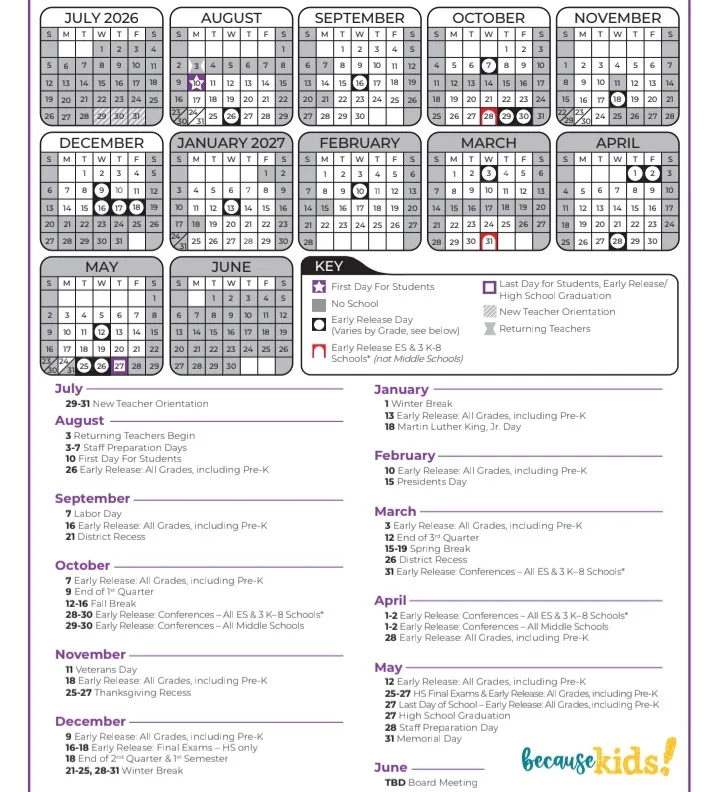
Arizona’s most populous county is served by roughly 50 public school districts, from Mesa, Chandler, and Scottsdale to Phoenix Union and dozens of smaller city, suburban, and rural systems. Together they enroll more than 600,000 students across about 9,200 square miles, plus a large charter sector. Because every district adopts its own calendar, no single “Maricopa County school calendar” exists. Intense summer heat pushes start dates into July, and the sheer number of districts means families can find very different schedules within a few miles of each other.
School District Structure in Maricopa County
Maricopa County is a county, and public education is organized through independent school districts, not one county-run system. Each district is led by an elected Governing Board, the title Arizona uses in place of “school board” or “Board of Education.” The board hires a superintendent, adopts the budget, and votes on the annual calendar. Boards generally meet monthly, usually in the evening, and agendas must be posted in advance under Arizona’s open meeting law. Larger districts often meet more than once a month.
Because the county has so many districts, a full list would run long. The major ones include:
- Mesa Unified School District No. 4, the largest in the county, with roughly 60,000 students
- Peoria Unified School District No. 11
- Chandler Unified School District No. 80
- Scottsdale Unified School District No. 48
- Gilbert Public Schools, District No. 41
- Deer Valley Unified School District No. 97
- Paradise Valley Unified School District No. 69
- Phoenix Union High School District No. 210, which serves Phoenix high school students and works alongside many separate elementary districts such as Roosevelt, Alhambra, Creighton, Osborn, Madison, Balsz, Cartwright, Isaac, and Washington Elementary
- Tempe Elementary District No. 3 and Tempe Union High School District No. 213
- Glendale Elementary and Glendale Union High School District
- Tolleson Elementary and Tolleson Union High School District
- Kyrene Elementary, Cave Creek Unified, Fountain Hills Unified, Higley Unified, Queen Creek Unified, and Litchfield Elementary
- Agua Fria Union High School District, Buckeye Elementary, Buckeye Union High School District, Dysart Unified, and Pendergast Elementary
- Small rural districts at the county’s edges, such as Wickenburg Unified, Arlington Elementary, Palo Verde Elementary, Saddle Mountain Unified, and Aguila Elementary
One quirk catches families off guard. Many parts of the Phoenix area still use separate elementary and high school districts, so a child may attend an elementary district with one calendar and then move to a union high school district with another. Siblings in different grades can end up on different schedules. The elected Maricopa County School Superintendent, whose office is in Phoenix, provides administrative and financial support to districts, but it does not set any district’s calendar. Your district’s central office and Governing Board decide that.
The county is overwhelmingly urban and suburban in its core, with fast-growing outer suburbs in the East Valley and West Valley and genuinely rural areas around Wickenburg, Aguila, and the far western desert. Resources and flexibility vary accordingly.
Academic Calendar Structure
Most Maricopa County districts begin in late July or the first half of August and finish in late May. Many Valley districts have moved to early starts, sometimes in the last week of July, to complete the first semester before winter break. Start dates can differ by a week or more between neighboring districts, which matters for families who move, use open enrollment, or have children in two districts. Districts generally release a draft or final calendar in the spring before the new school year, and some adopt it a year or more ahead.
The typical layout looks like this:
- Fall semester: begins in late July or August and ends in December, so high school finals often fall just before winter break.
- Spring semester: begins in early January and runs through May.
- Grading periods: Most districts use quarters within semesters. Some elementary schools use trimesters or mid-quarter progress reports. Confirm with your child’s school.
- Daily schedule: Start and end times vary widely. Many elementary schools run from early morning to mid-afternoon, and middle and high schools often start earlier or later than elementary schools to stagger bus routes. Some districts also offer early-release Wednesdays or Fridays.
Arizona requires 180 instructional days and sets minimum instructional hours by grade level. As commonly cited, that is about 356 hours for kindergarten, 712 for grades 1 through 3, 890 for grades 4 through 8, and 720 for high school. Some Maricopa County schools meet the requirement with a standard five-day week, while others use modified schedules, so ask your district which applies.
One practical point for newcomers: Arizona, including Maricopa County, stays on Mountain Standard Time all year and does not shift clocks for daylight saving time. Sunrise and sunset therefore stay fairly consistent, and school bell times do not change in March or November.
School Holidays and Breaks
Districts decide which breaks to include and how long they last. Common patterns in Maricopa County include:
- Labor Day: observed in early September.
- Fall break: Many Valley districts build in a week-long break in October, often tied to the end of the first quarter. Some use a shorter break.
- Thanksgiving break: usually Wednesday through Friday, and some districts take the full week.
- Winter break: typically about two to three weeks around Christmas and New Year’s Day.
- Martin Luther King Jr. Day: observed in mid-January. Arizona designates the day as Martin Luther King Jr./Civil Rights Day.
- Presidents’ Day: observed in February, usually as a single day, sometimes paired with a longer weekend.
- Spring break: usually one week in March. The timing varies by district, partly because of spring training baseball and the Valley’s winter visitor season.
- Memorial Day: observed in late May, near the end of the school year.
Some districts also close for local observances or days tied to parent-teacher conferences. Exact dates shift every year, so the board-adopted calendar on your district’s website is the only reliable source.
Families comparing very different parts of the state, such as the sparsely populated western river county and the Phoenix metro area, may find it useful to read the La Paz County Arizona Schools Calendar page alongside the Maricopa County Arizona Schools Calendar page. Together they show how a handful of small rural districts differ from a large metropolitan system in start dates, break structure, and heat planning.
How to Find the Official Maricopa County School Calendar
Start with the district that serves your address. Visit that district’s website and look under sections labeled “District,” “Parents,” “Families,” or “Community.” Calendars are usually posted as PDFs, and many districts also offer a digital version you can add to a phone or computer calendar.
Governing Boards commonly vote on the next year’s calendar in the spring, and some adopt calendars further ahead. If you cannot find the current year’s version, call the district office. Individual schools may also publish supplemental calendars covering concerts, parent conferences, sports, and fundraisers. These supplement the district calendar and do not replace it, so check both.
If you are unsure which district serves your home, the Maricopa County School Superintendent’s office or the Arizona Department of Education can help identify boundaries. This question comes up often in areas where elementary and high school boundaries do not line up, such as parts of Phoenix, Glendale, Tolleson, and the West Valley.
Early Release Days, Teacher Workdays, and Professional Development
Teachers generally report a week or so before students return for planning and training. Many districts also schedule professional development days during the school year when students are not in attendance, and some build a weekly early-release or late-start schedule so staff can collaborate. Large districts such as Mesa, Chandler, and Peoria publish these details on their adopted calendars, and individual schools may add their own early-release days for conferences.
Non-student days and early-release days appear on the adopted district calendar. Districts also announce them through automated calls or texts, school apps, newsletters, and social media pages. Make sure your phone number and email are current in your district’s student information system. Arizona does not set a single statewide training-day schedule for every district, so each district builds its own non-student days within the 180-day and instructional-hour rules.
Emergency Closures and Weather Days
Snow is rare in the Valley, so closures here come from different causes. Extreme heat is a real planning issue, especially in the early weeks of the school year, and districts may adjust recess, outdoor activities, athletics, and bus operations during excessive-heat warnings. Monsoon season brings dust storms, flash flooding, and power outages from July through September, and storms can occasionally disrupt school days. Outer areas such as Wickenburg, Aguila, and the far West Valley can be affected by washed-out roads, and wildfire smoke or air-quality advisories sometimes affect outdoor activities.
Closure and delay decisions are made by each district, typically by the superintendent after consulting facilities, transportation, and emergency officials. Full-day closures are uncommon. When a district does lose instructional time, it may recover it through calendar adjustments or built-in buffer days. Ask your district which approach it follows.
To find out whether school is canceled:
- Check your district’s website, app, and social media pages first.
- Watch for automated calls, texts, or emails from the district.
- Follow Phoenix television stations such as KPNX 12News, KTVK 3TV/Arizona’s Family, KSAZ Fox 10, and KNXV ABC15.
- Check local radio and the Arizona Republic or community newspapers.
- Call the district transportation office if you are unsure whether a bus is running on your route.
Graduation and End-of-Year Schedule
High school final exams generally take place in the last week or two of May, with fall-semester finals in December. High school graduation ceremonies usually happen in May, and larger districts commonly hold them at school stadiums or at large venues such as Desert Diamond Arena in Glendale or university arenas. Because so many seniors graduate in the same few weeks, check your school’s schedule early. Elementary and middle schools commonly hold promotion or recognition ceremonies in the final week.
Report cards are issued at the end of each grading period, and nearly all large districts offer a parent portal for grades and attendance. Ask your child’s school for login information early in the year rather than waiting until a concern comes up.
Back-to-School and Registration Information
Enrollment and re-enrollment typically open in spring, with new-student registration continuing through summer and the school year. Typical requirements include:
- Proof of residency, such as a utility bill or lease
- A certified birth certificate or other proof of age
- Up-to-date immunization records, as required under Arizona law
- Previous school records, if transferring
Many Maricopa County districts offer online registration, and some also have central enrollment offices. Arizona’s open enrollment law allows families to apply to schools outside their home attendance boundary, and many Valley districts publish open enrollment windows each winter. Because capacity varies, apply early and check each district’s timeline. School supply lists are usually posted on school websites or announced in summer, and many schools hold open houses, orientations, or meet-the-teacher events just before classes begin. These appear on the district calendar or in school newsletters.
Special Programs and Their Calendar Implications
Several programs may follow a different schedule from the standard K-12 calendar:
- Career and technical education: East Valley Institute of Technology (EVIT) and West-MEC serve high school students from many districts, and their calendars may differ from the home school’s.
- Magnet and specialty schools: Many districts, including Phoenix Union, Mesa, and Scottsdale, offer academies and choice schools with separate application windows and sometimes different bell times.
- Dual enrollment and early college: Maricopa Community Colleges, including Mesa, Scottsdale, Chandler-Gilbert, and Phoenix College, offer courses for high school students that follow the college calendar, not the district’s. Arizona State University also partners with some schools.
- Preschool and early childhood: Head Start and district preschools may run fewer days per week or follow a slightly different calendar.
- Alternative schools: Many districts offer alternative or credit-recovery programs with flexible hours.
- Virtual learning: Arizona families can access online options, including district-run programs and statewide providers, which typically use their own calendars.
- Charter schools: Maricopa County has a large charter sector, and these schools set their own calendars independent of the district.
Confirm the schedule directly with any program your child attends.
Athletics and Extracurricular Calendar Context
High school sports in Maricopa County are governed by the Arizona Interscholastic Association (AIA), which sets season dates, eligibility rules, and playoff structures. Athletic schedules are separate from the academic calendar but linked to it. Fall sports begin in the opening weeks of school, and heat can affect practice and game times in early August and September. Playoffs can overlap with exam periods or fall near breaks. Because the Valley is large, travel between schools can be long even within the county, and rivalry games among districts such as Mesa, Chandler, Gilbert, and Scottsdale are major local events. Check your school’s athletic calendar alongside the academic one.
State-Level Calendar Requirements and How Arizona Law Governs Maricopa County
The Arizona Department of Education oversees public school standards, and state law sets the 180-day instructional minimum and the instructional-hour minimums by grade level. Within those limits, local Governing Boards have wide flexibility. They choose start and end dates, break lengths, early-release schedules, and whether to use a four-day week. That is why Maricopa County districts can differ from one another and from rural districts elsewhere in the state. Districts must also meet state requirements for testing windows and reporting, and charter schools operate under separate state authority.
Frequently Asked Questions
When does school start in Maricopa County, Arizona?
Most districts begin between late July and mid-August. Each district sets its own date, so check the calendar for the district that serves your address.
When does school get out for summer in Maricopa County?
Most districts end the year in late May. Some finish a little earlier or later depending on their calendar.
How many days are in a school year in Maricopa County?
Arizona requires at least 180 instructional days, plus minimum hours by grade level. Some districts exceed the minimum, and some meet it through longer days or different weekly schedules.
How do I find out if school is canceled today in Maricopa County?
Check your district’s website, app, and text or call alerts. Phoenix television stations and local news sites are also useful, and you can call the district office or transportation department. Full-day closures are rare in the Valley.
What is the spring break schedule for Maricopa County schools?
Spring break is usually one week in March, but dates vary by district. The adopted calendar lists exact days.
How do I enroll my child in Maricopa County schools?
Contact the district that serves your address, or apply through open enrollment if you want a school outside your boundary. You will generally need proof of residency, a birth certificate, and immunization records. Many districts accept online registration.
Are there any year-round schools in Maricopa County?
Most schools follow a traditional calendar with a summer break, though some districts and charters offer balanced calendars or intersessions. Ask your district whether any of its schools use a modified schedule.
Who do I contact about school calendar questions in Maricopa County?
Start with your school’s front office or your district’s central office. To find out which district serves your address, you can contact the Maricopa County School Superintendent’s office in Phoenix.
One Comment